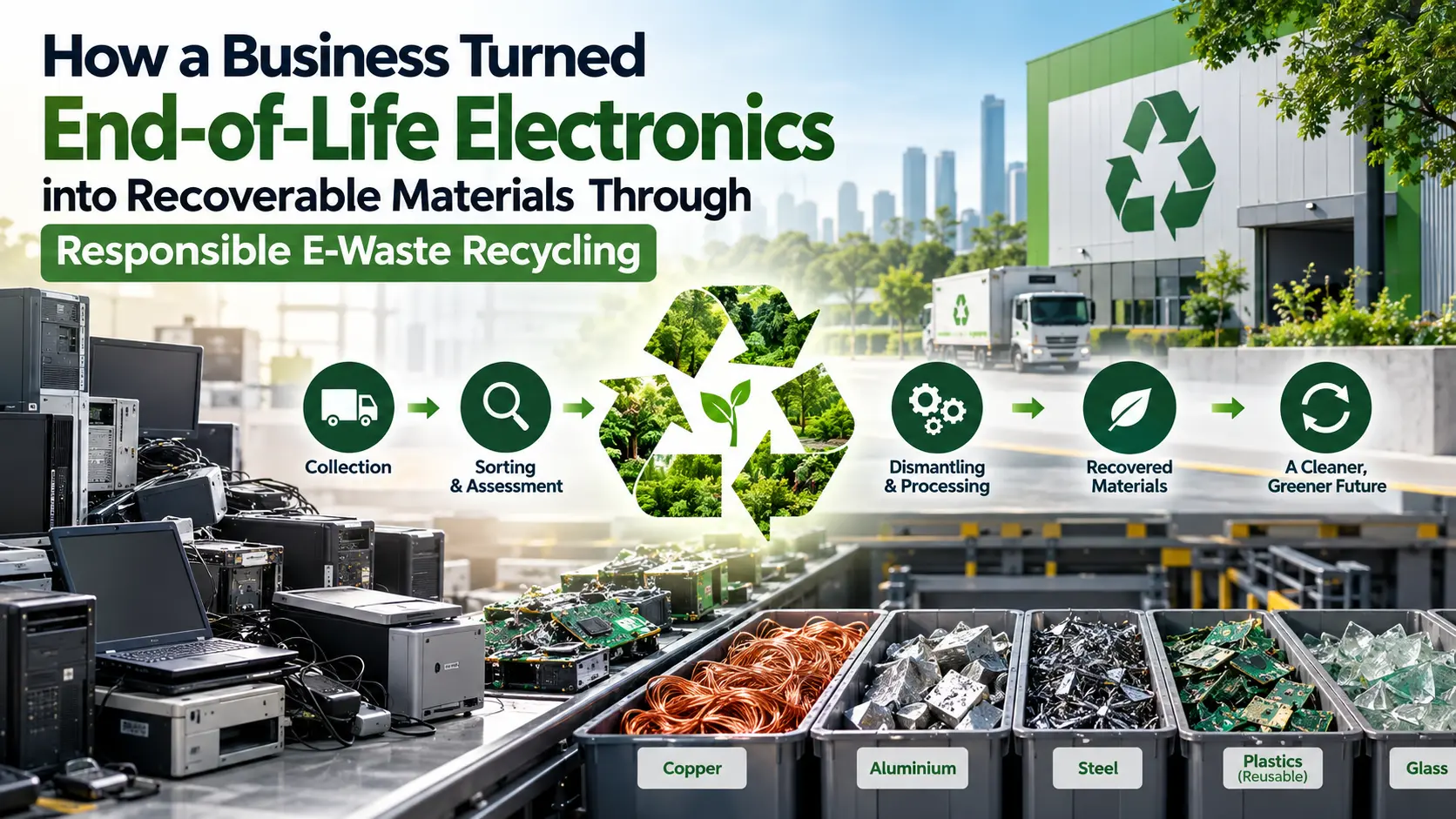
How a Business Turned End-of-Life Electronics into Recoverable Materials Through Responsible E-Waste Recycling
For many businesses, replacing outdated electronic equipment is a routine part of keeping operations efficient. Laptops are upgraded, desktops are replaced, networking equipment reaches the end of its useful life, and older electronic components gradually become unusable. What often receives less attention is what happens to these devices after they are removed from service.
For one of GreenTek Reman’s clients, this became an important business and sustainability challenge. It was a popular tech-based company in Noida, a growing organisation with a technology-intensive workplace and a regular requirement to upgrade its electronic infrastructure. Over time, a significant quantity of outdated computers, networking equipment, peripherals, electronic components, and other end-of-life devices had accumulated.
The organisation did not want these assets to remain in storage indefinitely, nor did it want electronic waste to be handled through an informal disposal route. Its objective was to establish a more responsible e-waste recycling process that could manage collection, logistics, end-of-life processing, and material recovery.
GreenTek Reman helped the company move from simply disposing of outdated electronics to treating e-waste as a potential source of recoverable materials. This case study explores how that transition was managed and why responsible e-waste recycling can create both environmental and operational value for businesses.
A Growing Business Faced a Rising End-of-Life Electronics and E-Waste Management Challenge
The client was an established business with a growing employee base and an increasing dependence on electronic equipment for everyday operations. As part of normal technology upgrades, older devices were periodically replaced with newer equipment. Some of the retired assets had reached the end of their practical working life, while others were no longer suitable for the company’s current operational requirements.
Initially, these devices were retained temporarily because the organisation wanted to determine the appropriate disposal route. As the volume increased, however, storage became inconvenient and inefficient.
Simply discarding the equipment was not considered an appropriate solution. Electronic devices contain a combination of materials and components that require responsible handling. At the same time, some devices may contain recoverable metals and materials that can re-enter productive use through appropriate recycling and recovery processes.
The company therefore began looking for a professional e-waste recycling partner rather than a conventional disposal channel.
Assessing the Client’s End-of-Life Electronic Equipment for Responsible Recycling
GreenTek Reman began by understanding the client’s e-waste inventory and the types of electronics that required collection. The equipment included different categories of obsolete or end-of-life devices, meaning that a single disposal approach would not necessarily be appropriate for everything.
The assessment helped establish a more structured workflow for collection, movement, sorting, processing, and recovery. This stage was important because responsible recycling begins before the equipment reaches a processing facility. Understanding what is being collected helps determine how assets should be handled, transported, segregated, and routed for further processing.
For the client, the assessment also provided a clearer picture of the scale of its e-waste challenge. Instead of seeing a warehouse or storage area filled with unwanted electronics, the organisation could now view the inventory as a defined stream of end-of-life assets requiring a planned management process.
PAN India E-Waste Collection and Reverse Logistics Simplified Asset Movement
Once the requirement had been assessed, the next challenge was collection and transportation. For businesses with significant quantities of electronic waste, moving equipment internally can quickly become complicated. Devices may be distributed across offices, storage areas, departments, or different operational locations.
GreenTek Reman supported the client through structured e-waste collection and reverse logistics. The objective was to move the equipment from the client’s locations into the appropriate recycling workflow while reducing the operational burden on its internal teams.
This was more than a transportation exercise. The movement of end-of-life electronics needed to form part of a controlled process that connected collection with downstream sorting, processing, recycling, and material recovery.
For the client, having a single partner coordinate these activities helped simplify the transition from on-site accumulation to responsible end-of-life management.
Sorting and Processing Helped Separate Recoverable Materials from E-Waste
Once the electronic waste entered the recycling workflow, the focus shifted towards determining how the collected materials could be processed responsibly. Electronic products consist of numerous materials, including metals, plastics, circuit boards, components, glass, and other material streams. Their recovery potential depends on the type and condition of the equipment and the applicable processing methods.
The purpose of responsible e-waste processing is not simply to break down electronics. It is to separate and recover materials in a controlled manner while ensuring that residual fractions are managed appropriately. For the client, this meant that equipment which had reached the end of its useful life as a product could still have value in the form of its constituent materials.
Recovering Valuable Metals from Electronics Created Additional Resource Value
Certain electronic components and equipment can contain recoverable metals such as copper and, depending on the material stream and processing route, other valuable metals including gold, silver, and palladium.
The presence and quantity of these materials can vary significantly from one type of electronic equipment to another. Therefore, responsible processing and appropriate material separation are essential.
For the client, the recovery process provided a practical demonstration that obsolete electronics should not automatically be viewed as material with no remaining value. Through responsible e-waste recycling, selected material streams could be processed for resource recovery rather than simply being treated as waste.
Documented E-Waste Processing Supported Greater Accountability and Traceability
For businesses, responsible e-waste management increasingly involves questions around documentation and accountability. An organisation may need to understand what equipment was collected, where it was sent, and how the end-of-life process was managed.
GreenTek Reman’s structured approach helped the client improve visibility around its e-waste movement and processing. Documentation creates greater confidence that retired electronics have entered an appropriate end-of-life route rather than disappearing into an untraceable disposal chain.
For larger organisations, this can be especially relevant when internal sustainability teams, compliance functions, procurement departments, or management need evidence of responsible waste handling.
The client therefore gained not only a cleaner workplace but also greater clarity around what happened to its obsolete electronic assets.
End-to-End E-Waste Management Gave the Client a More Practical Recycling Solution
One of the strongest advantages of working with GreenTek Reman was that the client did not have to coordinate every stage independently. Collection, reverse logistics, e-waste processing, recycling, and resource recovery can become fragmented when multiple vendors are involved.
An integrated e-waste management approach can simplify that chain. GreenTek Reman helped bring the relevant activities together so that the client’s requirement could be handled as one organised workflow.
This reduced coordination effort and provided a clearer path from the initial collection of obsolete equipment to its eventual recycling and material recovery. For businesses with larger electronic waste volumes, this type of end-to-end approach can make responsible recycling more practical to implement.
Why Businesses Should Build a Planned End-of-Life E-Waste Recycling Strategy
The experience of this client highlights a broader challenge faced by many organisations. Technology refresh cycles are accelerating, which means businesses are regularly retiring laptops, desktops, servers, monitors, networking devices, printers, accessories, and other electronic equipment.
A structured e-waste recycling strategy allows companies to prepare for end-of-life equipment before volumes become difficult to manage. Such a strategy can include scheduled collection, reverse logistics, segregation, recycling, resource recovery, documentation, and responsible downstream processing.
For businesses operating multiple locations, a planned approach can also support more consistent e-waste handling across the organisation.
GreenTek Reman’s Role in Business E-Waste Recycling and Material Recovery
GreenTek Reman supports businesses in managing electronic waste through collection, logistics, end-of-life processing, recycling, and resource recovery. Its e-waste management capabilities are designed to help organisations address the complete lifecycle of electronic waste rather than relying on informal disposal practices.
The focus extends from collection and movement to responsible recycling and recovery of usable materials, including precious and non-precious metals where applicable through appropriate processing.
GreenTek Reman also works with businesses seeking structured approaches to IT asset disposition, secure data sanitization and destruction, reverse logistics, and other end-of-life technology requirements.
This integrated capability can be particularly useful when a business needs to manage both IT assets and broader categories of electronic waste through coordinated channels.
Final Outcome
Responsible e-waste recycling allows organisations to reduce storage burdens, improve disposal accountability, support sustainability goals, and recover materials that still retain resource value.
The experience of GreenTek Reman’s client demonstrates what is possible when e-waste is approached as a managed material stream rather than as ordinary waste. From collection and reverse logistics to recycling and material recovery, every stage contributes to a more responsible end-of-life process.