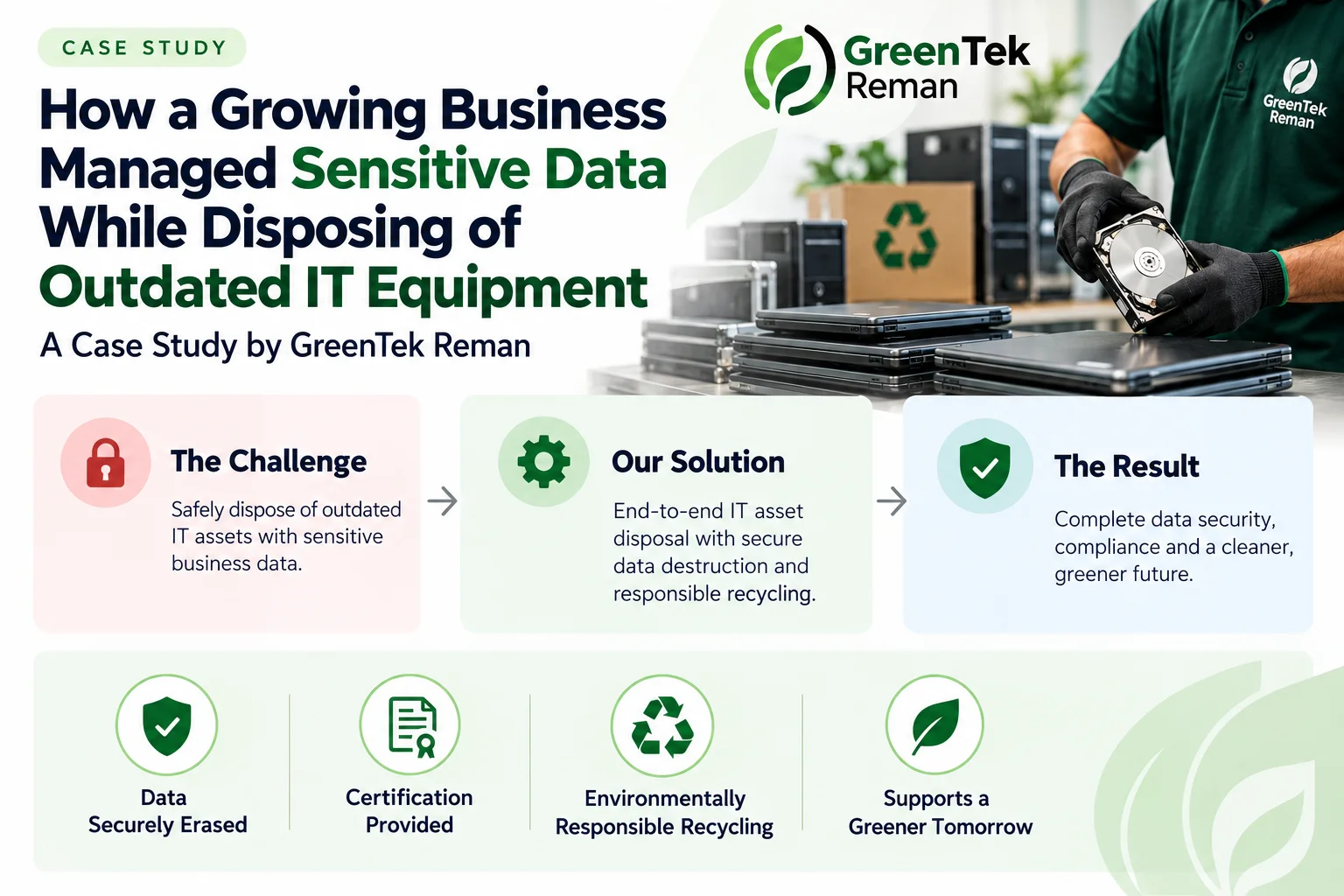
How a Growing Business Managed Sensitive Data While Disposing of Outdated IT Equipment: A Case Study by GreenTek Reman
For one of our clients, a growing business with operations in Delhi NCR, an expanding workforce and increasing dependence on digital systems created the need to upgrade its IT infrastructure. With approximately 200 employees across administrative, technical, finance, and customer-facing functions, the organisation had accumulated a considerable number of outdated computers, laptops, hard drives, and networking devices.
The business wanted to retire these assets without exposing sensitive information, disrupting regular operations, or contributing to irresponsible electronic waste disposal. It needed a dependable solution that could combine secure data sanitization, organised IT asset disposition, transparent documentation, and environmentally responsible recycling.
GreenTek Reman stepped in to help address these requirements through a structured IT Asset Disposition (ITAD) and e-waste management approach. The objective was to protect business information, establish accountability throughout the disposal process, and ensure that obsolete IT equipment was managed responsibly.
The Business Challenge: Protecting Confidential Data During Old IT Equipment Disposal
Devices that are no longer required for daily work may still contain sensitive information, including employee records, customer databases, financial documents, internal communications, business contracts, and login credentials.
Simply deleting files or performing a quick factory reset does not necessarily ensure that all stored information has been securely removed. Depending on the storage medium and the method used, data may remain recoverable even after a device appears to be empty.
Our client recognised that disposing of outdated IT equipment without an appropriate data security process could expose the organisation to unnecessary risks. Unauthorised access to residual information could affect customer confidence, compromise internal business records, and create avoidable compliance concerns.
Managing activities internally would require additional time, specialised processes, and coordination between IT, administration, finance, and compliance teams. The business therefore needed a professional ITAD partner capable of managing the end-of-life equipment process while prioritising data protection and responsible e-waste disposal.
Understanding the Client’s Requirements for Secure IT Asset Disposition
Before planning the disposal process, it was important to understand the client’s operational priorities and data security concerns. The first requirement was secure data sanitization. Storage devices needed to undergo an appropriate process to make sensitive information inaccessible before equipment could be reused, dismantled, or recycled. Where reuse was not appropriate, the client needed a suitable destruction method.
The second requirement was systematic asset identification. The organisation wanted better visibility into the equipment being retired, including its type, condition, and disposition status. This would help the internal IT team maintain clearer records and support the company’s asset management procedures.
The third requirement was reliable collection and handling. Retired equipment needed to be collected and transported through an organised process rather than being left in office storage areas or transferred informally between departments.
Finally, the business wanted documentation demonstrating how the assets had been processed. Records of data sanitization, destruction, recycling, and asset disposition could help the organisation maintain internal accountability and support relevant audits.
GreenTek Reman’s IT Asset Disposition services provided a suitable framework for addressing these requirements through coordinated asset handling, secure data sanitization, and responsible end-of-life management.
GreenTek Reman’s Approach: A Structured ITAD Process for Sensitive Business Data
GreenTek Reman approaches IT asset disposition as a process that extends beyond physical equipment collection. The objective is to manage retired IT assets in a way that considers information security, asset lifecycle management, material recovery, and environmental responsibility.
For a business managing confidential information, the process begins with understanding the assets involved and identifying the appropriate treatment for each category of equipment.
The approach can include asset inventory, collection and logistics, data sanitization, physical destruction where necessary, assessment for reuse or recovery, and documentation of the completed activities.
By bringing these activities into a coordinated process, businesses can reduce the burden on their internal IT teams and establish a clearer path for managing obsolete technology.
As an ITAD and e-waste management service provider, GreenTek Reman supports businesses in managing outdated equipment while helping them address the risks associated with residual data and improper disposal. Its services include data sanitization, equipment destruction, asset disposition, and environmentally responsible e-waste processing.
Step 1: Identifying and Categorising Outdated IT Assets Before Disposal
The first stage of a planned IT equipment disposal programme is to establish what needs to be retired. Without a reliable inventory, organisations may overlook storage devices, misidentify equipment, or lose visibility into the assets being processed.
An organised asset identification process helps businesses record the equipment being retired and establish a clear reference for subsequent handling. Depending on the available records and the scope of the engagement, relevant details may include asset identification numbers, equipment types, serial numbers, storage media, and current condition.
For the client, the key objective was to move away from an informal disposal approach and towards a more structured process in which each identified asset could be tracked through its intended disposition.
Step 2: Secure Data Sanitization to Protect Confidential Business Information
GreenTek Reman offers data sanitization services using appropriate techniques selected according to the storage media and the required outcome. These methods can include software-based overwriting, degaussing for suitable magnetic media, and physical destruction techniques such as shredding or disintegration when required.
The choice of method matters because not every technique is appropriate for every device. Software-based sanitization may be suitable when a storage device is intended for reuse and can support the required process. Physical destruction may be necessary when a device is damaged, cannot be reliably sanitised, or must not return to service. Degaussing is applicable to compatible magnetic media and is not suitable for every modern storage technology.
For the client, the intended outcome was to ensure that sensitive business information was handled through an appropriate sanitization or destruction process before the relevant equipment moved to its next stage.
Step 3: Choosing the Right Data Destruction Method for Each Storage Device
Not all retired IT assets present the same data security requirements. The appropriate method depends on the type of storage media, its condition, the sensitivity of the information, and whether the equipment is intended for reuse or permanent destruction.
For instance, a functioning storage device may be eligible for an appropriate sanitization process if the organisation permits reuse and the method meets its requirements. A defective drive that cannot be reliably sanitised may require physical destruction. Where magnetic storage media is involved, degaussing may be considered when technically suitable.
GreenTek Reman’s data sanitization and destruction services allow businesses to address these different requirements without relying on a single method for every device. By treating data sanitization as a specific operational requirement, businesses can establish a more controlled approach to retiring laptops, desktops, servers, and storage media.
Step 4: Organised IT Equipment Collection and Secure Transportation
After identifying the assets and establishing the required handling process, the next challenge is moving retired equipment out of the workplace safely and efficiently.
GreenTek Reman provides IT asset collection and logistics support to help organisations manage the physical movement of end-of-life equipment. Its ITAD services include asset removal and secure transportation to its processing facilities, with logistics support available across India.
In the client’s case, the objective was to ensure that outdated devices were handled as part of an organised disposal programme rather than treated as miscellaneous office waste. Appropriate handover records and asset tracking procedures are important throughout this stage. They help businesses maintain visibility into which equipment has been released for processing and which items remain under internal control.
Step 5: Responsible IT Asset Disposition, Reuse, and E-Waste Recycling
Secure data handling is essential, but it is only one part of responsible IT equipment disposal. Once the required data sanitization or destruction activities have been completed, the equipment must be directed towards an appropriate next step.
GreenTek Reman supports businesses through IT asset disposition and e-waste management services that consider the end-of-life requirements of different electronics. Equipment that can be appropriately recovered or reused may follow a different route from devices that are damaged, obsolete, or unsuitable for further use.
The client wanted to ensure that retired devices did not simply leave the office without a defined destination. Incorporating responsible recycling into the disposal plan helped connect information security with broader environmental responsibility.
Step 6: Maintaining ITAD Documentation and Data Destruction Records
For businesses handling sensitive information, completing the physical disposal of IT equipment is not necessarily the end of the process. Internal stakeholders may also need evidence of what was collected, how the assets were handled, and whether the required sanitization or destruction activities were completed.
Documentation supports accountability by creating a record of the asset disposition process. Depending on the scope of the engagement and the services performed, relevant documents may include asset inventories, processing records, data destruction certificates, recycling certificates, and compliance-related reports.
GreenTek Reman provides documentation associated with its asset processing, data destruction, and recycling services, subject to the applicable service and processing requirements.
For the client, this aspect of ITAD was particularly important because it helped connect the practical work of disposing of old equipment with the organisation’s internal governance procedures.
A documented process can also make future asset retirement easier. Businesses can review previous records, identify recurring equipment replacement needs, and improve the way they manage IT assets throughout their lifecycle.
However, documentation should accurately reflect the activities actually performed. Organisations should confirm the scope of each certificate or report and retain the records according to their internal policies and applicable obligations. When combined with secure sanitization and organised asset handling, proper documentation creates a more transparent approach to end-of-life IT equipment management.
Step 7: Supporting Environmental Responsibility Through Sustainable E-Waste Management
GreenTek Reman combines IT asset disposition with responsible e-waste management to help businesses manage their obsolete electronics appropriately. Its services include recycling and material recovery, with a focus on reducing unnecessary waste and supporting more sustainable resource use.
For the client, environmentally responsible disposal was an important part of the overall requirement. The business wanted to retire its old IT infrastructure without treating electronic equipment as ordinary rubbish.
A structured recycling process helps direct end-of-life equipment towards appropriate recovery and treatment pathways. It can also support an organisation’s wider sustainability objectives by encouraging better resource management and more responsible technology lifecycle planning.
For organisations seeking to combine secure IT disposal with environmental responsibility, integrating data sanitization and e-waste management into a single planned process can simplify coordination and improve oversight.
Conclusion
Disposing of outdated IT equipment is an important responsibility for any business that handles confidential information. Old laptops, desktops, servers, and storage devices may continue to contain sensitive data long after they have been removed from active use.
As demonstrated by the case study approach, effective IT asset retirement requires more than simply removing obsolete hardware from the workplace. It involves identifying assets, selecting appropriate data sanitization or destruction methods, organising collection and transportation, maintaining relevant records, and ensuring that end-of-life electronics are managed responsibly.
GreenTek Reman helps businesses bring these priorities together through its IT Asset Disposition, data sanitization, equipment destruction, and e-waste management services.