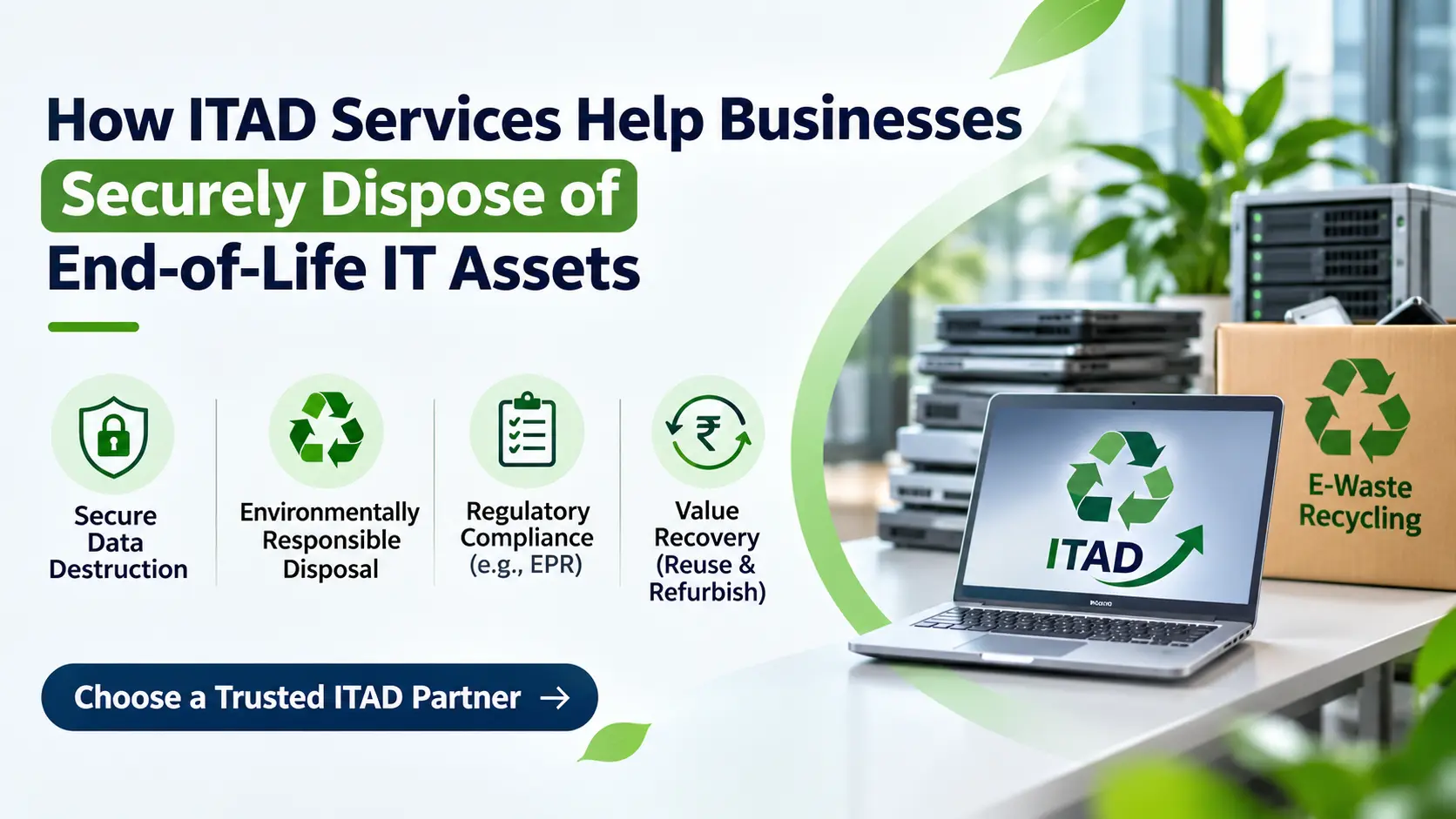
How ITAD Services Help Businesses Securely Dispose of End-of-Life IT Assets
Replacing outdated IT equipment is often necessary to maintain operational efficiency, but disposing of old devices requires careful planning. Simply selling, discarding, or sending obsolete electronics for conventional recycling can expose businesses to data security threats, regulatory complications, and environmental risks. This is where IT Asset Disposition (ITAD) services become important.
ITAD provides businesses with a structured approach to managing end-of-life IT assets through secure data sanitisation, physical data destruction, asset evaluation, recovery, refurbishment, recycling, and responsible disposal. It ensures that organisations can retire their technology infrastructure without compromising sensitive information or overlooking environmental responsibilities.
For enterprises handling large volumes of electronic equipment, professional ITAD services are not merely a disposal solution. They are an important part of corporate data security, IT asset lifecycle management, regulatory compliance, and sustainability planning.
This blog explores how ITAD services help businesses securely dispose of end-of-life IT assets and why choosing an experienced ITAD partner is essential for responsible asset management.
Why Businesses Need Professional ITAD Services for End-of-Life IT Equipment Disposal
Managing obsolete IT equipment internally can become challenging, particularly for organisations operating across multiple offices, warehouses, manufacturing facilities, and business locations.
Without a defined disposal process, old electronics may remain unused in storage rooms, get transferred without proper documentation, or reach unauthorised disposal channels.
Professional IT asset disposition helps businesses address these challenges through a structured and accountable approach.
Preventing Data Breaches Through Secure IT Asset Disposal Services
One of the biggest concerns associated with retiring IT equipment is the possibility of sensitive information falling into unauthorised hands.
Businesses store substantial amounts of confidential information across their IT infrastructure. This may include customer databases, employee records, intellectual property, financial documents, internal communications, and business strategies.
Deleting files or formatting a hard drive does not necessarily guarantee permanent data removal. Information may remain recoverable through specialised recovery tools. If such devices are sold, transferred, or discarded without appropriate data sanitisation, organisations could unintentionally expose confidential information.
Depending on the storage media and security requirements, these methods may include secure overwriting, degaussing, shredding, and physical disintegration. A documented data destruction process helps organisations establish accountability and maintain greater control over information throughout the asset disposal lifecycle.
Maintaining Regulatory Compliance Through Responsible ITAD and E-Waste Management
Electronic waste contains materials that require appropriate handling and processing. Improper disposal can create environmental hazards and expose businesses to regulatory consequences.
Businesses should ensure that their obsolete electronic equipment is transferred through appropriate authorised channels and processed in accordance with applicable regulations.
For manufacturers, producers, importers, and other entities with specific Extended Producer Responsibility (EPR) obligations, proper e-waste management also plays an important role in meeting applicable compliance requirements.
Reducing Environmental Impact Through Sustainable IT Asset Recycling
End-of-life electronic equipment contains valuable recoverable materials, including copper, aluminium, steel, and precious metals. However, when discarded without appropriate processing, these resources may be lost, while hazardous components can contribute to environmental contamination.
ITAD services promote responsible precious metal recovery by identifying equipment suitable for reuse, refurbishment, dismantling, and recycling. This approach reduces unnecessary resource extraction, encourages material conservation, and supports corporate sustainability objectives.
How ITAD Services Securely Manage the Complete End-of-Life IT Asset Disposal Process
A professional ITAD programme involves several interconnected stages. Each stage is designed to maintain asset accountability, protect sensitive information, and ensure that equipment reaches the appropriate end-of-life destination.
IT Asset Inventory and Assessment for Controlled Hardware Disposal
Businesses may have hundreds or thousands of devices distributed across different departments and locations. These can include laptops, desktops, servers, hard drives, SSDs, printers, networking equipment, telecom devices, and other electronic assets.
An organised inventory process helps record relevant asset details, including equipment type, specifications, identification numbers, physical condition, and ownership information. Once the inventory is established, the equipment can undergo technical inspection to determine its functionality and recovery potential.
This assessment helps classify devices according to their next possible use, whether refurbishment, component recovery, or recycling.
Secure IT Asset Collection and Reverse Logistics for End-of-Life Equipment
After asset identification, the equipment must be collected and transported through a controlled process. For enterprises with multiple branches, offices, and facilities, coordinating the movement of obsolete IT equipment can become a major logistical challenge.
Professional ITAD providers help streamline this process through planned collection schedules, asset handling procedures, and reverse logistics support. Secure transportation is particularly important because retired devices may still contain sensitive information before undergoing data sanitisation.
A properly managed chain of custody helps maintain accountability from the point of collection to the processing facility. This is especially valuable for banks, financial institutions, healthcare organisations, IT companies, educational institutions, and large enterprises handling confidential information.
Certified Data Sanitisation and Permanent Data Destruction for Business IT Assets
Data sanitisation is among the most critical stages of secure IT asset disposition. Its purpose is to make stored information inaccessible through methods appropriate to the storage media and the organisation’s security requirements.
Depending on the equipment and data destruction policy, different techniques may be used. Secure data wiping involves overwriting stored information to prevent its recovery through standard data retrieval methods.
Degaussing uses a powerful magnetic field to disrupt data stored on compatible magnetic media. It is generally unsuitable for SSDs and other non-magnetic storage technologies. Physical shredding reduces storage media into small fragments, making the original data-bearing device unusable.
Disintegration provides another physical destruction approach for media requiring controlled disposal. Businesses should select the appropriate method based on the storage technology, security classification, and applicable data retention requirements.
Common IT Asset Disposal Mistakes Businesses Should Avoid During ITAD Implementation
Even organisations with established IT departments can overlook important aspects of end-of-life equipment management. One common mistake is assuming that deleting files or performing a factory reset permanently removes all stored information. Businesses should use appropriate data sanitisation procedures instead of relying on basic deletion methods.
Another mistake is storing obsolete equipment indefinitely without maintaining proper inventory records. Untracked devices can create security vulnerabilities and make asset accountability difficult.
Some organisations also prioritise the resale value of old equipment without first addressing data security. Data sanitisation should be completed before equipment is reused, resold, or transferred.
Choosing an unauthorised or inexperienced recycling partner can create additional environmental and compliance risks. Businesses should evaluate the provider’s certifications, processing capabilities, documentation practices, and applicable regulatory authorisations.
Finally, failing to maintain disposal records can make internal audits and compliance verification more difficult. A structured ITAD programme helps avoid these issues by integrating data security, asset management, recycling, and documentation into one coordinated process.
GreenTek Reman: Your Trusted Partner for Secure ITAD Services and Responsible E-Waste Management in India
Choosing the right ITAD partner is essential for businesses that want to protect confidential information while ensuring responsible disposal of end-of-life IT assets. GreenTek Reman is Asia-Pacific’s first R2v3 Certified ITAD and E-Waste Management company, offering comprehensive solutions for organisations looking to manage their obsolete IT infrastructure securely and sustainably.
With expertise in IT Asset Disposition, data sanitisation, product and equipment destruction, e-waste recycling, and precious metal recovery, GreenTek Reman supports businesses throughout the end-of-life asset management process.
Its key strengths include:
R2v3 Certified ITAD and E-Waste Management: GreenTek Reman follows the internationally recognised R2v3 framework for responsible electronics reuse and recycling practices.
Secure Data Sanitisation and Destruction: Businesses can access data sanitisation, degaussing, hard drive shredding, disintegration, and other appropriate data destruction methods to protect sensitive information.
On-Site and Off-Site Data Destruction: Depending on operational and security requirements, data destruction can be arranged at client premises or at the processing facility.
PAN India IT Asset Collection: GreenTek Reman supports nationwide asset collection and reverse logistics, helping enterprises coordinate obsolete equipment retrieval across multiple locations.
Asset Evaluation and Value Recovery: Technical inspection and hardware salvage value assessment help identify opportunities for refurbishment, reuse, and component recovery.
Responsible E-Waste Recycling and Precious Metal Recovery: Its processing capabilities support the recovery of valuable materials from end-of-life electronics while promoting sustainable resource utilisation.
Documentation and Process Transparency: Asset tracking, data destruction certificates, recycling certificates, and relevant processing documentation help businesses maintain records and accountability.
GreenTek Reman also holds ISO certifications, supporting its focus on quality management, environmental management, information security, and occupational health and safety. With its processing facility in Greater Noida and corporate presence in New Delhi, GreenTek Reman works with businesses across India to develop customised ITAD and e-waste management solutions.
Its approach is guided by the principles of Reduce, Reuse, and Recycle, helping organisations move beyond conventional disposal practices towards responsible IT asset lifecycle management.
Whether your organisation needs secure data destruction, bulk IT asset pickup, server disposal, laptop recycling, office IT equipment dismantling, or comprehensive ITAD support, GreenTek Reman helps manage the process with a focus on data protection, compliance, and environmental responsibility.
Conclusion
Disposing of outdated IT equipment is an important responsibility for every organisation. Without appropriate procedures, retired devices can become potential sources of data breaches, regulatory complications, and environmental damage.
Professional ITAD services help businesses address these challenges through secure asset collection, data sanitisation, physical destruction, hardware value recovery, and responsible e-waste recycling.