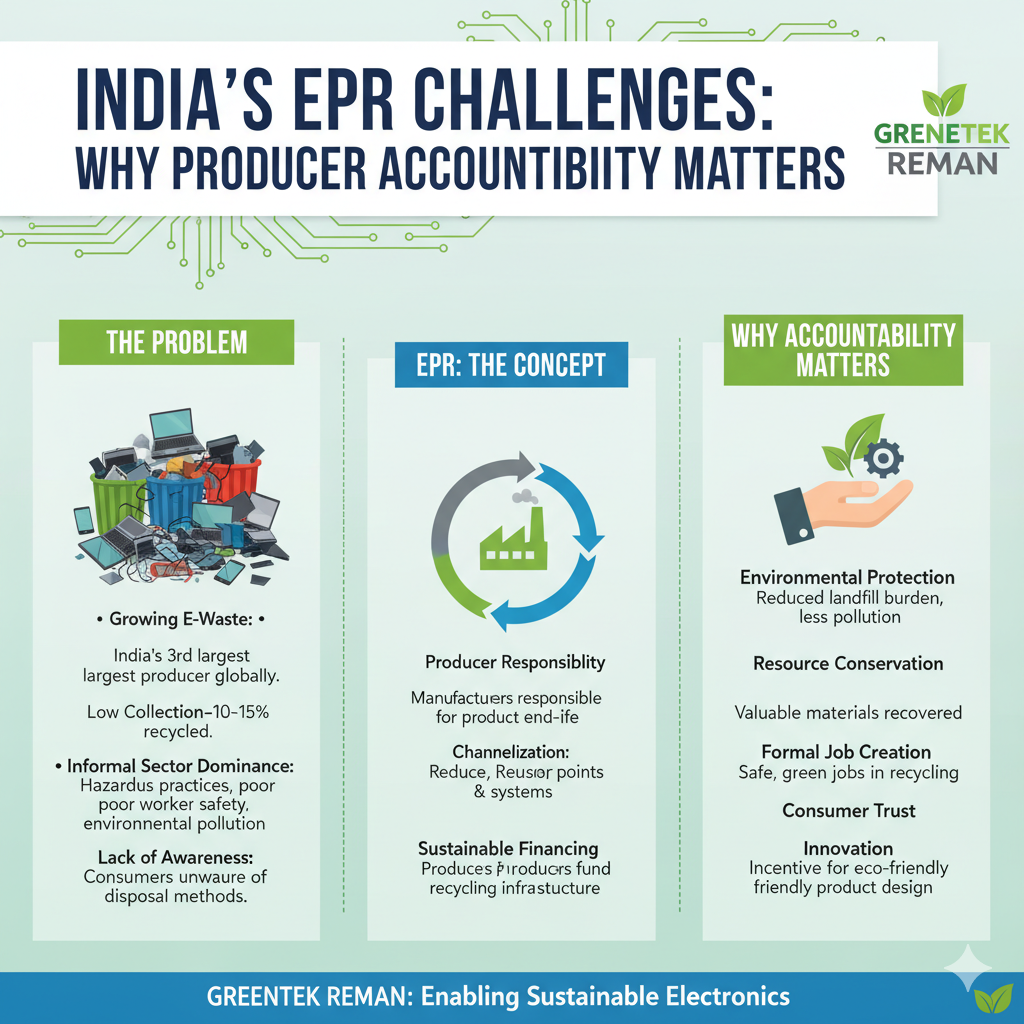
India’s EPR Challenges: Why Producer Accountability Matters
India is producing more electronic waste than ever before. From phones and laptops to air conditioners and smartwatches, our love affair with gadgets is creating a not-so-smart mountain of discarded electronics. But here’s the real kicker: most of this e-waste doesn’t get treated the way it should. Enter the concept of Extended Producer Responsibility (EPR), the policy approach meant to make producers responsible for the post-consumer stage of their products.
Sounds fair, right? You make it, you deal with it. But the reality is more complicated than it looks on paper. Despite having a legal framework in place, EPR challenges in India continue to plague even the most well-intentioned recycling goals.
The EPR Framework: A Quick Refresher
Extended Producer Responsibility is a policy strategy that shifts the burden of managing electronic waste from governments and consumers to the companies that manufacture and sell these products. Ideally, producers are supposed to:
Collect used electronics
Under Extended Producer Responsibility (EPR), manufacturers are expected to take back their products once consumers are done using them. This could be through collection centers, mail-back programs, or doorstep pickups. The goal is to keep electronics out of landfills and bring them into a proper recycling loop.
Recycle or refurbish them
Once collected, the electronics must either be safely dismantled and recycled or refurbished for reuse. Recycling recovers valuable metals and components, while refurbishment extends the life of the product. Both methods help reduce e-waste and support a circular economy.
File regular compliance reports
Producers are also required to submit detailed reports to government authorities showing how much e-waste they’ve collected and processed. These reports help regulators track progress, ensure accountability, and keep the entire EPR system transparent and effective.
In India, this framework is governed by the E-Waste (Management) Rules, most recently updated in 2022. While the rules are more structured now, the actual implementation is where the struggle begins.
The Core EPR Challenges in India
1. Lack of Awareness Among Producers
Many producers, especially small and medium enterprises (SMEs), are unaware of their responsibilities under EPR. Either they don’t fully understand the rules or underestimate the consequences of non-compliance. This gap in awareness has led to superficial adherence rather than systemic change.
2. Unorganised Informal Sector
India has a vast, informal e-waste recycling ecosystem. While these small-scale recyclers play a significant role in collecting waste, their processes are often unsafe and inefficient. Worse, they don’t feed data back into the formal system, making it nearly impossible to track compliance.
3. Data Discrepancies and Reporting Issues
One of the major EPR challenges in India is the lack of reliable data. Producers are expected to submit detailed reports on the amount of waste collected and processed. But without real-time tracking or integrated software systems, the reports often become an exercise in creative writing.
4. Compliance Without Accountability
Just because a company files an EPR report doesn’t mean it’s actually collecting and recycling responsibly. Many firms outsource their obligations to third-party organizations without conducting audits or verifications. In other words, it’s compliance on paper, chaos in practice.
5. Low Collection Targets vs. High Generation Rates
The e-waste generation rate in India is alarmingly high, but the official collection targets are comparatively modest. This disconnect gives producers little incentive to go above and beyond. If the bar is set low, why jump higher?
6. Inadequate Infrastructure
Let’s be honest: our recycling infrastructure could use a serious upgrade. While metro cities have access to a few certified recyclers, smaller towns and rural areas are largely left out of the loop. This makes pan-India compliance a logistical nightmare.
7. Frequent Policy Shifts
The rules have been updated several times over the past decade, and while evolution is necessary, the lack of consistency adds confusion. Frequent policy tweaks make it hard for businesses to align their long-term strategies with government mandates.
Why Producer Accountability Matters
Imagine selling someone a burger but never cleaning up the wrapper, multiply that by a billion, and you’ve got the global e-waste problem. Producer accountability ensures that the environmental cost of products is factored in from the design stage. Here’s why it matters:
Encourages eco-design
When producers know they’ll be held accountable for disposing of their products, they tend to think ahead, right from the design stage. This means using recyclable materials, modular components, and less toxic substances to make future recycling easier and safer. It’s sustainability by design, not just by law.
Promotes transparency
EPR forces companies to trace their products beyond the point of sale, leading to better tracking of materials throughout the supply chain. This end-to-end visibility not only improves accountability but also helps spot inefficiencies and risks that might otherwise go unnoticed.
Protects the environment
Electronics often contain hazardous substances like lead, mercury, and cadmium. Without proper recycling, these can leach into soil and water. Responsible disposal under EPR ensures toxic materials are safely handled, minimizing environmental harm and public health risks.
Builds consumer trust
Today’s buyers are paying attention. When companies show they’re serious about sustainability and take responsibility for their products, it builds brand credibility.
The Role of Technology in Solving EPR Challenges
Technology can’t solve everything, but it can definitely help with:
Real-time tracking of collected and recycled waste
This technology allows producers and recyclers to monitor the movement and status of e-waste at every stage, i.e., collection, transportation, and processing. It improves transparency, prevents data manipulation, and ensures timely reporting. Real-time updates also help identify bottlenecks or non-compliant vendors quickly.
Blockchain-based verification of compliance reports
Using blockchain ensures that compliance data is secure, tamper-proof, and fully traceable. Each recycling or collection entry becomes a permanent digital record, reducing the chances of falsified reports. It adds credibility to EPR reporting and boosts regulatory trust in the process.
AI-driven forecasting to predict e-waste generation
Artificial Intelligence can analyze product sales, usage trends, and lifecycle data to estimate future e-waste volumes. This helps producers plan better collection strategies and infrastructure. Forecasting also supports government and recyclers in developing long-term, scalable solutions.
Mobile apps to improve consumer participation in take-back programs
User-friendly apps can guide consumers to locate nearby drop-off points, schedule pickups, or earn rewards for recycling responsibly. These tools simplify the take-back process and boost awareness. By making recycling more accessible, mobile apps bridge the gap between policy and public action.
How GreenTek Reman Is Leading the Charge
At GreenTek Reman, we’re not just ticking boxes, we’re setting benchmarks. As one of India’s leading e-waste management and IT asset disposition (ITAD) companies, we specialize in solutions that make producer responsibility achievable, efficient, and impactful.
What Makes Us Different?
- Pan-India presence: Whether you’re in Mumbai or Delhi, our logistics network ensures seamless pickup and delivery.
- Certified processes: From data destruction to safe metal recovery, every step follows global best practices.
- Customized EPR services: We don’t believe in one-size-fits-all. Our tailored EPR services help brands stay compliant while meeting their sustainability goals.
- Transparent reporting: Real-time dashboards and detailed reports mean no guesswork, just accountability.
GreenTek Reman doesn’t just manage e-waste; we help producers become part of the solution. Our expertise bridges the gap between compliance and action, making us the go-to partner for brands that take responsibility seriously.
Conclusion
Solving the EPR challenges in India isn’t about handing out more rulebooks. It’s about creating an ecosystem where producers, recyclers, and regulators work in sync. Producer accountability isn’t just a policy requirement; it’s an ethical imperative. And as India strides toward a circular economy, companies have a pivotal role in shaping that journey. At the end of the day, it’s simple: if you put something into the world, you should know where it ends up.