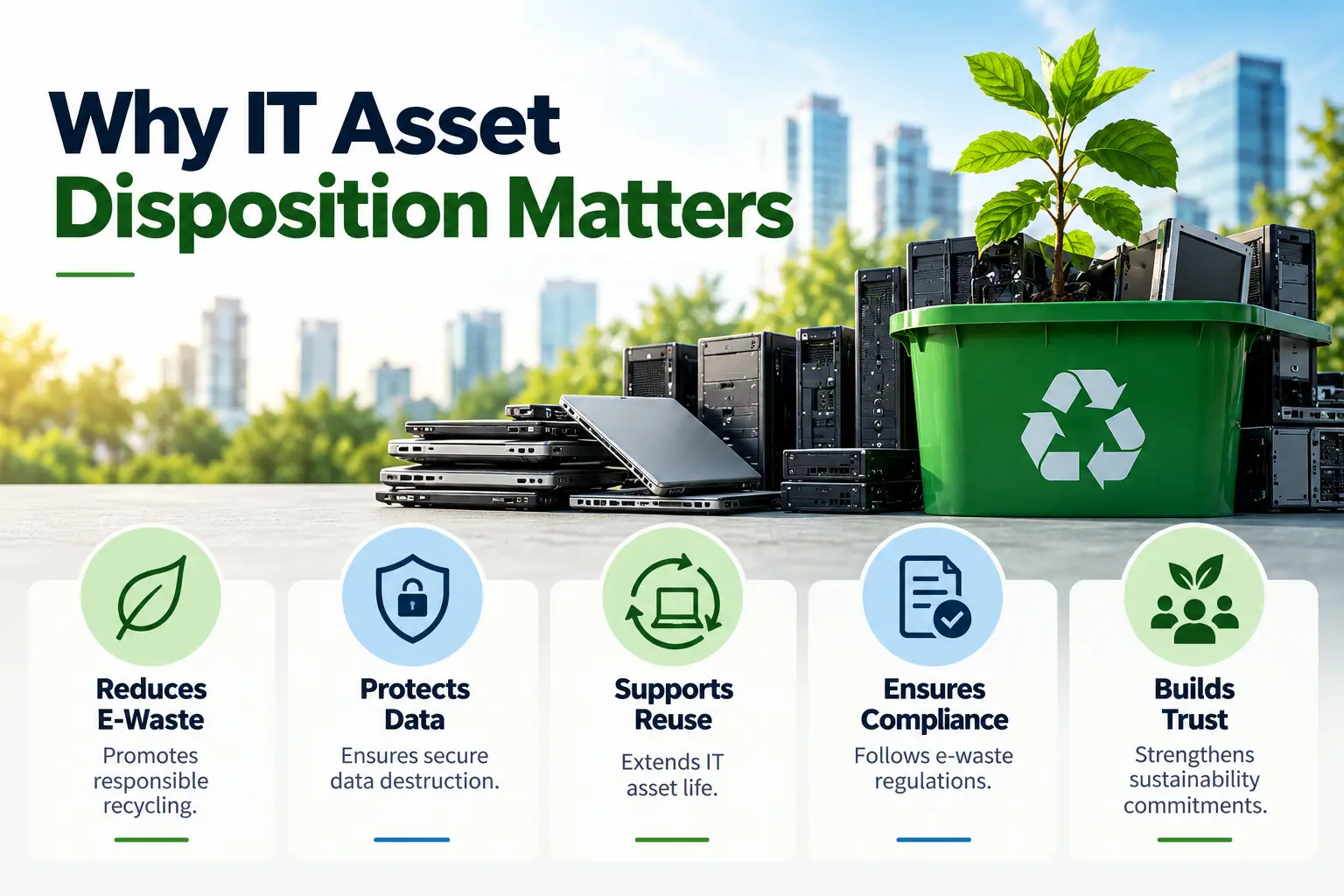
Why IT Asset Disposition Is Important for Corporate Sustainability
Corporate sustainability is no longer limited to reducing paper consumption, conserving electricity, or introducing environmentally friendly office practices. As businesses become increasingly dependent on digital infrastructure, the responsible management of electronic equipment has emerged as an important part of their environmental and operational responsibilities.
This is where IT Asset Disposition (ITAD) becomes important. A structured IT asset disposition process helps businesses manage retired equipment through secure data sanitisation, refurbishment, reuse, resale, component recovery, and responsible recycling. It creates a systematic way to handle end-of-life electronics while supporting environmental objectives and responsible resource management.
1. Reducing Electronic Waste Through Responsible IT Asset Disposal
Electronic waste, commonly known as e-waste, includes discarded electrical and electronic equipment and its components. As organisations upgrade their technology infrastructure, retired computers, servers, monitors, and other devices contribute to this growing waste stream.
The scale of the challenge is significant. According to the Global E-waste Monitor 2024, the world generated approximately 62 million tonnes of e-waste in 2022, of which only 22.3% was documented as formally collected and recycled in an environmentally sound manner. The report projected that annual e-waste generation could reach 82 million tonnes by 2030.
When organisations retire equipment without a structured process, usable devices may be discarded alongside damaged electronics. Equipment can also enter poorly controlled waste channels, making it difficult to establish how it is handled or whether valuable materials are recovered safely.
IT asset disposition helps businesses avoid treating every retired device as waste. Through asset assessment and appropriate processing, working equipment can be refurbished or reused, while non-functional devices can be channelled to suitable recycling facilities.
This approach helps reduce the volume of electronics unnecessarily discarded and supports more responsible end-of-life IT equipment management.
For businesses handling large quantities of IT assets, a documented ITAD programme can also make electronic waste management more consistent across departments, branches, warehouses, and data centres.
2. Supporting the Circular Economy Through Reuse and Refurbishment
A circular economy seeks to retain the value of products and materials through practices such as maintenance, repair, reuse, refurbishment, remanufacturing, and recycling. IT asset disposition supports this transition by prioritising suitable reuse opportunities before equipment is dismantled or recycled.
For example, a business may retire a batch of laptops because it is standardising its workforce on newer configurations. Although the devices may no longer meet the original department’s requirements, some could remain suitable for administrative tasks, educational use, or other less demanding applications after testing and refurbishment.
Instead of sending these devices directly for recycling, an ITAD process can identify which units can safely return to productive use. Extending equipment life can help delay demand for replacement devices and the materials, manufacturing processes, and transportation associated with producing them.
The environmental benefit depends on factors such as equipment condition, refurbishment requirements, energy efficiency, and the extent to which reuse actually substitutes for new purchases.
3. Conserving Natural Resources Through Material Recovery
Electronic devices contain a combination of materials, including iron, aluminium, copper, plastics, glass, and smaller quantities of other valuable metals. These materials support the functioning of modern technology, but their extraction and processing can involve considerable resource use and environmental impacts.
When electronic equipment is improperly discarded, recoverable materials may be lost. Conversely, responsible e-waste recycling can help return suitable materials to manufacturing supply chains.
IT asset disposition supports this process by separating equipment suitable for reuse from devices that require material recovery. Recovered materials may then be used as secondary raw materials, depending on their quality and the capabilities of downstream processors.
Material recovery does not eliminate the need for virgin resources, and not every component can be recovered economically. Nevertheless, recycling suitable electronics can reduce avoidable material losses and contribute to more efficient resource use.
Organisations can evaluate how much equipment is reused, how much is recycled, what material recovery information is available, and whether downstream processing can be verified. Such information helps businesses assess the practical contribution of their ITAD programme rather than relying on general environmental claims.
4. Lowering the Environmental Impact of Technology Replacement
The environmental footprint of a computer or server extends beyond its electricity consumption during use. Raw material extraction, manufacturing, component assembly, transportation, packaging, and eventual treatment also contribute to its overall lifecycle impact.
Frequent hardware replacement can increase demand for newly manufactured products, particularly when existing equipment remains functional and could continue serving an appropriate purpose. However, older equipment may also consume more electricity, lack essential security support, or fail to meet modern business requirements. The most sustainable decision depends on the circumstances.
A responsible ITAD strategy helps organisations make better-informed choices by assessing whether equipment can be redeployed, repaired, refurbished, or remarketed before it is recycled.
In other cases, continued use may not be practical because of energy efficiency, performance, reliability, or security considerations. Recycling can then help recover materials while preventing equipment from entering inappropriate disposal channels.
5. Protecting Data Security During IT Asset Retirement
Corporate sustainability includes responsible business management, and information security is an essential part of that responsibility. Retired IT equipment may contain customer information, employee records, financial documents, business correspondence, intellectual property, access credentials, and other sensitive data.
If equipment leaves an organisation without appropriate data sanitisation, confidential information could be exposed through resale, unauthorised access, or improper handling. IT asset disposition addresses this risk by incorporating secure data sanitisation into the equipment retirement process.
Depending on the storage technology, data classification, organisational policy, and intended reuse, appropriate methods may include verified data erasure, cryptographic erasure where applicable, or physical destruction of storage media when necessary.
6. Improving Corporate ESG Performance and Sustainability Reporting
Environmental, Social, and Governance considerations increasingly influence how businesses evaluate their operations, supply chains, risk management, and long-term performance. Within the environmental dimension, electronic waste management and responsible resource use are relevant areas for organisations that regularly purchase and replace IT equipment.
A well-managed ITAD programme can generate useful information for sustainability reporting, including the number and categories of retired assets, quantities reused or refurbished, amounts sent for recycling, and available evidence of downstream processing.
However, businesses should avoid treating all disposed equipment as automatically recycled or assuming that every transferred device produces a measurable environmental benefit. A transparent approach helps organisations communicate their progress credibly and identify areas where their electronic waste management practices can improve.
7. Supporting Regulatory Compliance and Responsible E-Waste Management
Businesses must consider applicable environmental regulations when managing end-of-life electronics. In India, the E-Waste (Management) Rules, 2022, together with applicable amendments and related requirements, establish a framework for managing covered electronic waste and assigning responsibilities to relevant stakeholders.
The specific obligations depend on the organisation’s role, the equipment involved, and the applicable regulatory provisions. Producers, manufacturers, refurbishers, recyclers, and other regulated entities may have different responsibilities.
A structured ITAD process helps organisations maintain inventory records, document equipment transfers, retain relevant processing evidence, and establish a clearer chain of custody from collection through final disposition. These records can support internal audits and help demonstrate that the business has followed its established procedures.
Organisations should verify the current requirements that apply to their operations and confirm the authorisation status and capabilities of their selected processing partners. Where extended producer responsibility obligations apply, the relevant regulated entities must meet their specific duties under the applicable framework.
Conclusion
Corporate sustainability requires organisations to consider the environmental and operational consequences of their decisions throughout the lifecycle of the products they use. IT equipment is an important part of this responsibility because digital infrastructure depends on materials, manufacturing processes, energy, and ongoing hardware replacement.