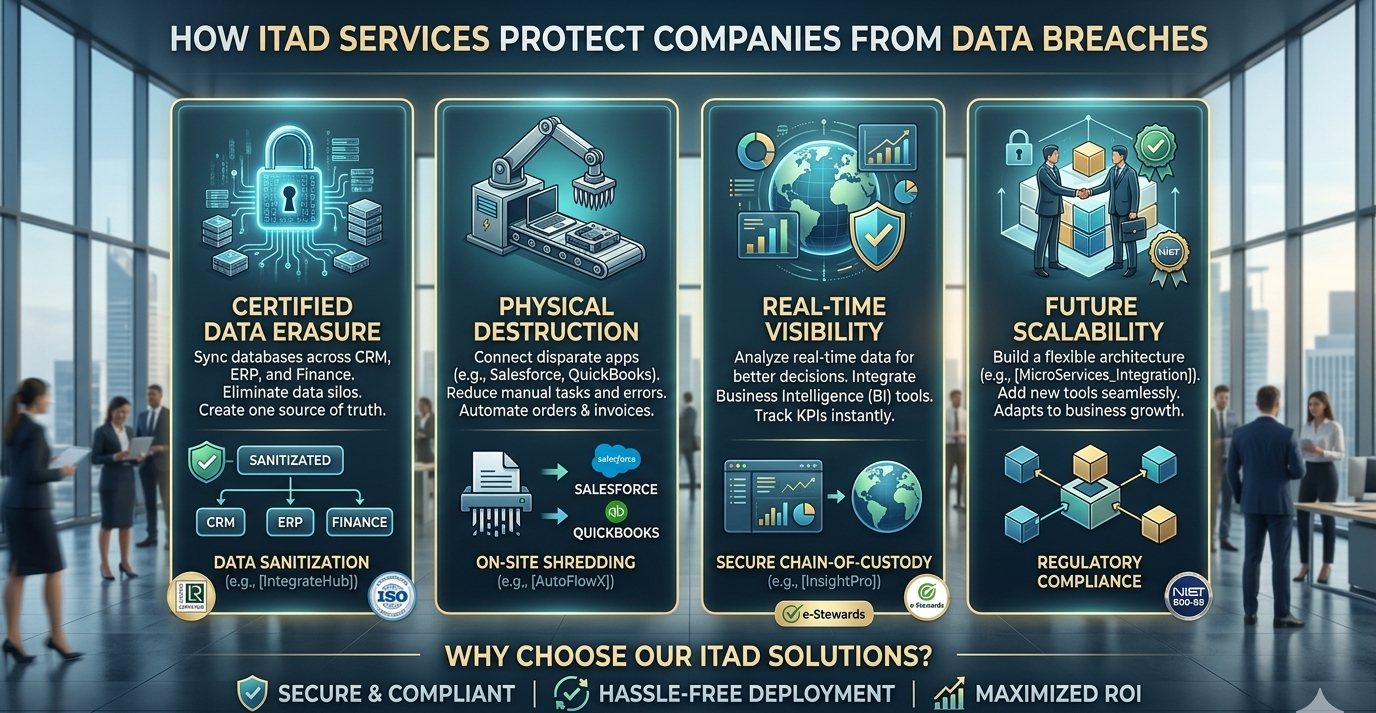
How ITAD Services Protect Companies from Data Breaches
Many organizations assume that once a device is no longer in use, it no longer poses a risk. This assumption can be costly. Even after deletion or formatting, data often remains recoverable using readily available tools. Hard drives, solid-state drives, and other storage media can retain sensitive information long after they have been decommissioned.
Retired IT assets may contain a wide range of confidential data, including customer information, financial records, intellectual property, employee details, and internal communications. If these devices are sold, recycled, or discarded without proper data sanitization, they can fall into the wrong hands.
Data breaches originating from improperly disposed hardware are not uncommon. In many cases, organizations face significant financial losses, legal consequences, and long-term reputational damage. The risk is amplified in industries that handle sensitive data, such as finance, healthcare, and technology.
IT Asset Disposition is a structured process that manages the retirement of IT equipment in a secure, compliant, and environmentally responsible manner. While it encompasses recycling and value recovery, one of its most critical functions is ensuring complete data destruction.
Professional ITAD services follow standardized protocols to track, process, and sanitize each asset. This includes secure collection, transportation, data erasure, and final disposition. Every step is documented to ensure transparency and accountability.
By implementing ITAD services, businesses can eliminate the risks associated with data remnants on retired devices. It transforms asset disposal from a potential vulnerability into a controlled and secure process.
How Data Breaches Occur Through Improper IT Disposal
ITAD services are designed not only to manage end-of-life IT equipment but also to ensure that all data contained within these assets is permanently and securely destroyed. By integrating security, compliance, and sustainability, ITAD has become a vital component of modern data protection strategies.
Data breaches linked to IT asset disposal often occur due to a lack of awareness or inadequate processes. Common scenarios include:
- Devices being sold or donated without proper data wiping
- Hard drives discarded in landfills or scrap markets
- Inadequate or incomplete data deletion methods
- Untracked assets that go missing during decommissioning
In many cases, businesses rely on basic deletion techniques, assuming that they are sufficient. However, simple deletion or formatting does not remove data permanently. Advanced recovery tools can easily retrieve this information.
Additionally, informal or unauthorized recycling channels may not follow secure handling practices, increasing the risk of data exposure. Without proper oversight, businesses lose control over their assets and the data they contain.
The Role of ITAD Services in Preventing Data Breaches
Secure Data Sanitization Techniques
One of the primary ways ITAD services protect companies is through certified data sanitization methods. These include data wiping, degaussing, and physical destruction, each chosen based on the type of storage media and security requirements.
Data wiping involves overwriting existing data with random patterns, making it irrecoverable. Degaussing uses powerful magnetic fields to disrupt the data stored on magnetic media. Physical destruction ensures that storage devices are completely destroyed, leaving no possibility of data recovery.
End-to-End Asset Tracking and Chain of Custody
Maintaining control over IT assets throughout the disposal process is crucial for preventing data breaches. ITAD services provide end-to-end tracking systems that document every stage of the asset lifecycle.
From the moment a device is decommissioned to its final disposition, it is tracked using unique identifiers. This creates a clear chain of custody, ensuring that no asset is lost or mishandled.
Secure Logistics and Handling
Transportation of retired IT assets is another critical point of vulnerability. Unauthorized access during transit can lead to data theft or loss. Professional ITAD providers use secure logistics processes, including sealed containers, GPS tracking, and controlled handling protocols. This ensures that assets remain protected throughout the journey.
By minimizing human intervention and implementing strict security measures, ITAD services reduce the risk of data exposure during transit.
The Role of ITAD in Supporting Remote and Hybrid Work Environments
The rise of remote and hybrid work has increased the complexity of IT asset management. Devices are often distributed across multiple locations, making tracking and disposal more challenging.
Employees may use company-issued laptops, tablets, and mobile devices from home or remote offices. When these devices reach the end of their lifecycle, retrieving and securely disposing of them becomes critical.
ITAD services provide solutions for collecting assets from multiple locations, ensuring secure handling and data destruction regardless of where the devices are located. This is particularly important in maintaining consistent security standards across distributed work environments.
Sustainability and Secure E-Waste Management
While data security is a primary focus, ITAD services also contribute to sustainable e-waste management. By refurbishing, recycling, and responsibly disposing of IT assets, they reduce environmental impact.
Secure data destruction ensures that devices can be safely repurposed or recycled without risking data exposure. This supports the principles of a circular economy, where resources are reused rather than discarded.
Businesses can align their data protection efforts with sustainability goals, creating a more responsible and efficient approach to IT asset management. As technology evolves, so do the methods used by cybercriminals. This makes it essential for businesses to stay ahead of emerging threats.
The ITAD industry is adopting advanced technologies such as automation, artificial intelligence, and blockchain to enhance security and transparency. These innovations enable better tracking, faster processing, and more reliable data destruction.
At the same time, regulatory requirements are expected to become more stringent, emphasizing the importance of secure data disposal. Businesses that invest in robust ITAD practices today will be better prepared for future challenges.
Protecting data is not just a technical process; it is also a cultural responsibility. Organizations must create awareness among employees about the risks associated with improper IT asset disposal. Clear policies, training programs, and internal communication can help ensure that everyone understands their role in maintaining data security. Employees should be encouraged to follow established procedures and report any issues related to asset management.
Conclusion
In a world where data breaches are becoming increasingly common, businesses must take a proactive approach to data protection. While much attention is given to securing active systems, the risks associated with retired IT assets cannot be ignored.