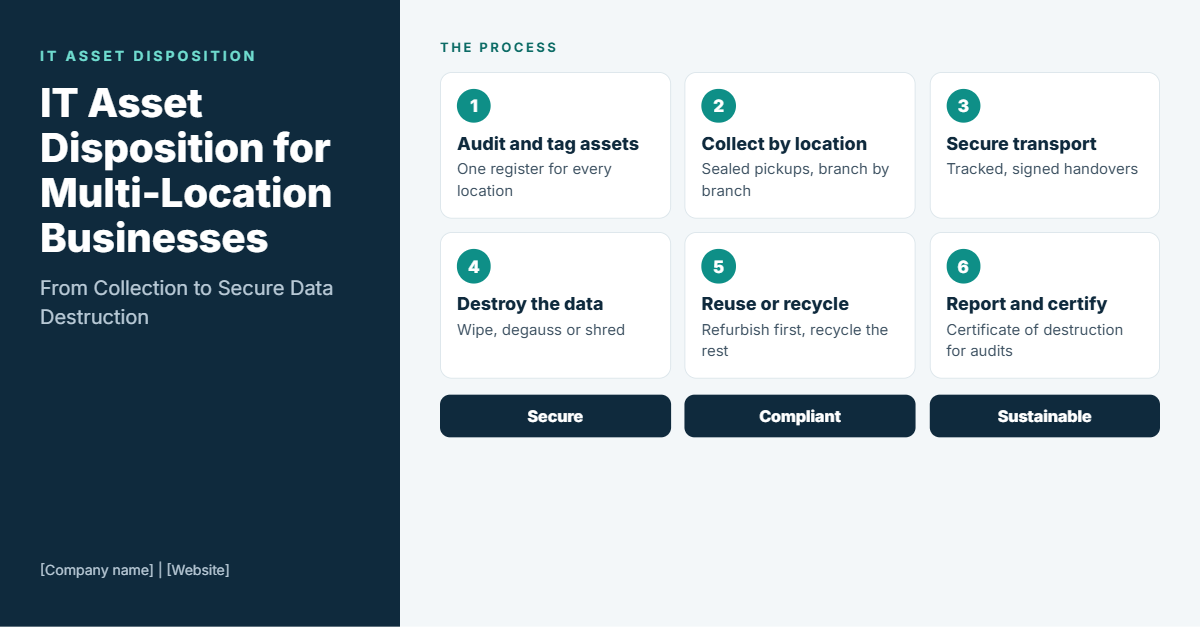
IT Asset Disposition for Multi-Location Businesses: From Collection to Secure Data Destruction
Managing IT equipment across multiple offices, branches, warehouses, data centres, and regional facilities can become a significant operational challenge as businesses grow. Every location generates its own requirements for hardware upgrades, equipment replacement, employee onboarding, and technology lifecycle management. Over time, these activities result in a growing inventory of obsolete laptops, desktops, servers, storage devices, networking equipment, printers, and other electronic assets.
While replacing outdated equipment is a normal part of business operations, deciding what happens to retired IT assets requires careful planning. Devices that are no longer useful to one department may still contain confidential business information, customer records, financial documents, employee details, or intellectual property. At the same time, disposing of electronics without an appropriate recovery and recycling process can contribute to the growing electronic waste problem.
This is where IT Asset Disposition (ITAD) becomes important. ITAD is the structured process of managing end-of-life IT equipment through inventory management, secure data sanitisation, asset recovery, refurbishment, recycling, and responsible disposal.
For multi-location businesses, IT asset disposition involves more than collecting old computers from individual offices. It requires a coordinated process that maintains visibility over assets, protects sensitive information, supports regulatory responsibilities, and ensures that electronic waste is handled responsibly.
A well-planned ITAD programme helps organisations manage the entire journey of retired equipment, from collection at different locations to secure data destruction and final material recovery. By establishing consistent procedures across their facilities, businesses can make IT asset retirement more secure, transparent, and environmentally responsible.
Centralised IT Asset Inventory Management for Businesses Operating Across Multiple Locations
Accurate inventory management is the foundation of an effective IT asset disposition programme. Before equipment can be collected or retired, the organisation needs to understand what assets it owns, where they are located, who is responsible for them, and whether they contain data requiring secure sanitisation.
In a multi-location environment, maintaining this information can be challenging. Different offices may follow different asset-tagging procedures, use separate inventory systems, or maintain records that are not updated consistently. Equipment may also move between departments or locations during its operational life.
A structured IT asset inventory helps address these issues by recording information such as asset tags, serial numbers, manufacturer details, device types, assigned locations, ownership records, and current condition.
When preparing for IT asset disposition, businesses should reconcile their inventory against the equipment physically available for collection. This process helps identify missing assets, discrepancies in records, and devices that require additional investigation before retirement.
Centralised records also help organisations coordinate collections more efficiently. Instead of arranging separate, unplanned disposal activities whenever equipment becomes obsolete, businesses can consolidate requirements by location, department, or retirement schedule.
PAN India IT Asset Collection and Reverse Logistics for Multi-Branch Organisations
Collecting retired IT equipment from multiple offices is one of the most demanding parts of enterprise ITAD. Equipment may be distributed across metropolitan offices, smaller branches, remote facilities, warehouses, and project locations, each with different operating schedules and access requirements.
Without a coordinated collection strategy, businesses may experience repeated transportation arrangements, incomplete asset records, unnecessary storage, and delays in retiring obsolete equipment.
Instead of managing every collection independently, businesses can work with GreenTek Reman to plan location-wise schedules, define packaging requirements, verify asset quantities, and coordinate transportation.
The collection plan should consider the nature of the equipment being moved. Laptops, desktops, servers, networking devices, and storage systems may require different handling arrangements. Equipment should be packed appropriately to reduce the risk of physical damage during transportation.
Businesses should also maintain documentation when assets change custody. Collection manifests, asset identifiers, handover records, and transportation details can help establish accountability throughout the process.
For organisations with numerous branches, reverse logistics planning can improve operational efficiency by consolidating collections and aligning them with hardware replacement schedules. It can also reduce the need for individual offices to identify separate disposal arrangements.
Effective reverse logistics ensures that retired IT equipment moves through a controlled process rather than remaining unaccounted for in office storage areas or being handled through informal disposal channels.
Secure Data Destruction and Data Sanitisation for Retired Corporate IT Equipment
Secure data destruction is one of the most critical stages of IT asset disposition. Retired IT equipment may contain information that remains commercially sensitive or subject to internal security policies even after the device is no longer in active use.
A company may be replacing laptops, desktops, servers, storage arrays, or networking equipment, but the information stored on associated drives and other media must still be protected. Simply deleting files, removing shortcuts, or performing a routine reset may not provide adequate assurance that sensitive information has been irreversibly removed.
Data sanitisation involves applying an appropriate method to make stored information inaccessible for unauthorised recovery. The selected approach depends on the storage technology, device condition, intended reuse, security requirements, and applicable procedures.
Software-based overwriting or other logical sanitisation methods may be appropriate for media that remains functional and is intended for reuse, provided the method is suitable for the storage technology and can be verified. Degaussing may be used for compatible magnetic media, while physical destruction, such as shredding or disintegration, may be appropriate when media cannot be reliably sanitised or must not be reused.
Multi-location businesses should establish a clear data destruction policy before equipment is collected. The policy should identify data-bearing assets, specify approved sanitisation or destruction methods, define verification requirements, and determine which records must be retained.
The organisation should also establish how exceptions will be handled. Damaged devices, inaccessible drives, encrypted storage, and assets with uncertain ownership may require additional assessment before they can be processed.
Data Destruction Certificates and Audit Documentation for Enterprise ITAD Compliance
Completing data destruction is only one part of a secure ITAD programme. Organisations also need evidence that the required process was carried out and that individual assets can be reconciled with their internal records.
Data destruction certificates, sanitisation reports, asset manifests, collection acknowledgements, and recycling documentation can provide an auditable record of the disposition process. The exact documents required will depend on the asset type, method used, contractual terms, and internal compliance policies.
For a business operating multiple locations, centralised documentation is particularly valuable. Instead of collecting inconsistent records from different offices, the organisation can maintain a common reporting framework that links collected assets to their final processing status.
Businesses should confirm that the documentation identifies the relevant assets and accurately describes the service performed. A certificate should not be treated as proof of a particular sanitisation method unless that method was actually applied and the documentation supports the claim.
Environmentally Responsible E-Waste Recycling for Multi-Location Businesses in India
Electronic waste contains a mixture of recoverable materials, components, and substances that require appropriate handling. When discarded equipment is managed improperly, it can contribute to environmental pollution and the loss of valuable resources.
For businesses retiring large quantities of IT equipment across several locations, responsible recycling should be a defined part of the ITAD process rather than an afterthought.
The first step is to separate assets according to their condition and appropriate processing route. Equipment suitable for reuse may be assessed for refurbishment, while non-reusable devices should be directed to suitable dismantling, recycling, and material recovery processes.
Electronic equipment can contain materials such as copper, aluminium, iron, and other metals, along with plastics, circuit boards, and components that may require specialised treatment. Depending on the equipment and processing method, valuable materials can be recovered for use in manufacturing and other industrial applications.
Businesses should work with appropriately authorised and qualified recycling partners and verify that downstream processing arrangements meet applicable requirements. Documentation should establish how equipment was handled and whether it entered the intended reuse or recycling route.
The process should also avoid informal disposal practices that can expose workers and communities to unsafe handling conditions or lead to uncontrolled environmental releases.
For multi-location businesses, a centralised e-waste management programme can help standardise collection, transportation, processing, and reporting across offices. It can also make it easier to consolidate disposal records and evaluate the organisation’s overall waste management performance.
Why Choose GreenTek Reman for IT Asset Disposition, Secure Data Destruction, and E-Waste Management?
Managing IT asset disposition across multiple locations requires a service partner that can coordinate collection, maintain asset visibility, protect sensitive information, and ensure that retired electronics are directed towards appropriate reuse or recycling processes.
GreenTek Reman provides end-to-end IT Asset Disposition services for businesses, including end-of-life asset management, PAN India pickup and transportation, data sanitisation, equipment assessment, refurbishment, and environmentally responsible e-waste management. The company identifies itself as Asia-Pacific’s first R2v3-certified ITAD and e-waste management company. Its published service portfolio also includes product and equipment destruction, precious metal recovery, and related reverse logistics services. These capabilities are relevant to organisations seeking a coordinated approach to retiring IT equipment across multiple facilities.
Through its ITAD services, GreenTek Reman helps businesses manage equipment removal, evaluate asset recovery opportunities, and arrange secure data sanitisation or destruction at client premises or its processing facility, depending on the service selected. Available methods include sanitisation or overwriting, degaussing for compatible media, shredding, and disintegration. Businesses can discuss applicable verification and documentation requirements when defining their service scope.
GreenTek Reman also emphasises transparent asset management and reporting. Maintaining clear records of collected equipment, processing activities, and final disposition helps organisations improve visibility over their retired assets and supports their internal audit requirements.
Environmental responsibility is another important aspect of the company’s service portfolio. Its focus on reuse, recycling, and recovery of valuable resources supports a more circular approach to managing obsolete electronics. Equipment that can be reused or refurbished may be evaluated accordingly, while non-reusable assets can be directed towards appropriate recycling and material recovery processes.
For organisations operating across India, PAN India collection capabilities can help coordinate IT asset pickup from different business locations. Rather than managing each branch’s disposal arrangements independently, businesses can explore a more centralised process aligned with their asset inventory, collection schedules, security requirements, and reporting needs.
GreenTek Reman’s R2v3 certification and established ITAD capabilities are relevant considerations when evaluating a service partner. However, organisations should still confirm the scope of services, applicable certifications, processing methods, collection arrangements, and documentation required for their particular assets and locations.
Conclusion
IT asset disposition is an essential part of technology lifecycle management for businesses operating across multiple offices and facilities. As organisations upgrade equipment and expand their IT infrastructure, they must ensure that retired devices are collected securely, sensitive information is properly sanitised or destroyed, and electronic waste is managed responsibly.
A structured ITAD programme brings these activities together through inventory management, coordinated collection, secure transportation, data destruction, asset assessment, recovery, recycling, and audit documentation.
For multi-location businesses, standardised procedures and centralised reporting are particularly important. They help organisations maintain visibility over retired assets, establish clear accountability, and reduce the risk of equipment being lost, mishandled, or disposed of without appropriate checks.
The most effective approach begins with an accurate asset inventory and a clearly defined retirement policy. From there, businesses can establish collection schedules, specify data sanitisation requirements, verify processing records, and select appropriate reuse or recycling routes.
GreenTek Reman’s ITAD, PAN India collection, secure data sanitisation, asset recovery, and e-waste management services provide businesses with options for developing a more organised end-of-life IT asset management process.