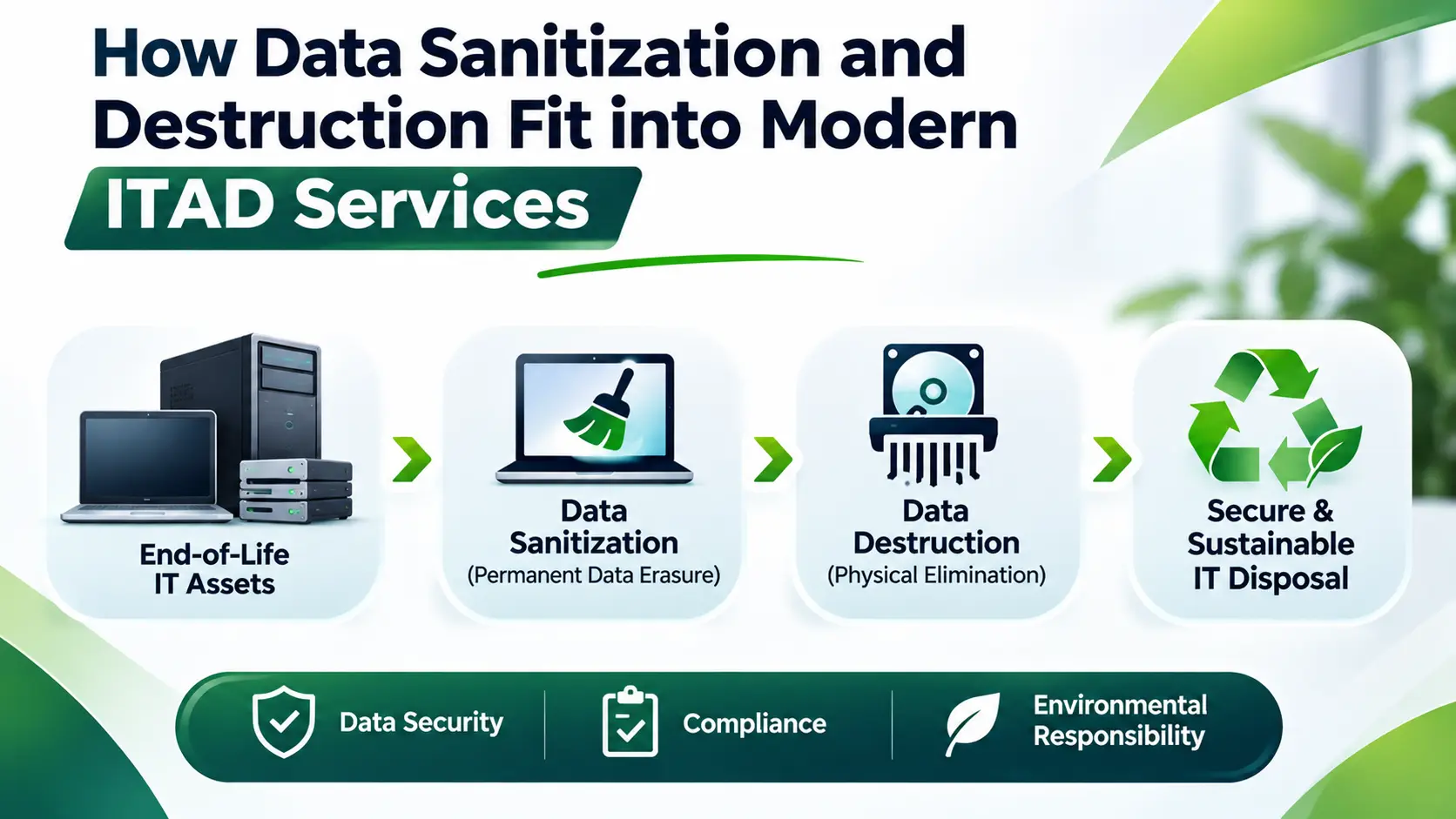
How Data Sanitization and Destruction Fit into Modern ITAD Services
As businesses upgrade their IT infrastructure, replace outdated equipment, expand operations, or close offices, large volumes of electronic assets eventually reach the end of their operational lifecycle. While disposing of these assets may appear to be a routine administrative activity, it involves an important responsibility that businesses cannot afford to overlook: protecting the information stored within them. This is where IT Asset Disposition (ITAD) becomes essential.
Modern ITAD services go beyond collecting and recycling obsolete electronic equipment. They incorporate structured processes for asset assessment, inventory management, secure data sanitization, physical data destruction, equipment refurbishment, material recovery, and environmentally responsible recycling.
Among these activities, data sanitization and destruction play a particularly important role because they help prevent sensitive information from falling into unauthorised hands after an organisation retires its IT equipment.
Understanding how secure data sanitization fits into modern ITAD services can help businesses make informed decisions about technology retirement, data security, regulatory responsibilities, and sustainable electronic waste management.
What Is IT Asset Disposition (ITAD) and Why Is It Important for Modern Businesses?
IT Asset Disposition, commonly known as ITAD, refers to the structured process of managing IT equipment when it is no longer required by an organisation. It covers the secure, responsible, and value-conscious handling of electronic assets at the end of their useful operational life.
Businesses regularly replace IT equipment because of technological upgrades, changing performance requirements, hardware failures, infrastructure expansion, or the completion of projects. This creates a continuous flow of retired devices that must be managed appropriately.
Common IT assets covered under ITAD services include laptops, desktops, workstations, servers, hard disk drives, solid-state drives, storage systems, networking equipment, printers, monitors, and other electronic peripherals.
A comprehensive ITAD programme generally involves asset identification, inventory preparation, collection, transportation, data sanitization, equipment testing, refurbishment, resale where appropriate, component recovery, and responsible e-waste recycling.
Without a structured IT asset disposal process, businesses may face data exposure risks, loss of recoverable asset value, poor disposal practices, and difficulties maintaining accurate records of retired equipment.
What Is Data Sanitization in ITAD Services and How Does It Work?
Data sanitization is the process of making information stored on a digital storage device inaccessible for recovery, according to an appropriate sanitization method and verification requirements. Unlike ordinary file deletion, secure data sanitization addresses the underlying storage media to prevent unauthorised recovery of previously stored information.
The method selected depends on the type of storage device, its condition, the sensitivity of the information, and whether the equipment is intended for reuse or recycling. For example, a functional laptop that is suitable for refurbishment may undergo an appropriate software-based sanitization process. A damaged storage device that cannot be reliably sanitized through software may require physical destruction.
The objective is to ensure that retired IT equipment does not carry recoverable confidential information into subsequent stages of handling. A professional ITAD process generally begins with identifying storage devices and assessing their condition. The appropriate sanitization or destruction method is then selected, followed by execution, verification where applicable, and documentation.
Different Data Sanitization Methods Used in Professional ITAD Services
The choice of data sanitization method depends on the storage technology, the condition of the device, the organisation’s security requirements, and whether the equipment is intended for reuse.
Modern ITAD providers use different approaches to ensure that information is securely removed or that storage media is physically destroyed when sanitization is not appropriate.
1. Software-Based Data Erasure and Secure Overwriting
Software-based data erasure involves using specialised tools to overwrite information stored on a storage device so that the original data cannot be recovered through ordinary data recovery methods.
Unlike deleting individual files or performing a standard format, secure overwriting addresses the stored data across the relevant addressable areas of the media according to the selected sanitization procedure. This method is useful when laptops, desktops, and other storage devices are still functional and may be suitable for refurbishment or reuse.
A successful sanitization process can allow businesses to retain the residual value of their IT assets without exposing previous users’ information. However, the effectiveness of software-based erasure depends on the storage technology, device condition, and the suitability of the chosen technique. Verification is an important part of the process.
2. Cryptographic Erasure for Encrypted Storage Devices
Cryptographic erasure is a data sanitization approach used with appropriately encrypted storage devices. When data is encrypted, it can only be accessed using the corresponding cryptographic keys. Cryptographic erasure involves sanitizing the relevant encryption keys so that the previously encrypted information becomes inaccessible.
This approach can be useful for modern storage environments where encryption has been implemented correctly throughout the data lifecycle. However, it is not automatically suitable for every encrypted device. Organisations must consider encryption coverage, key management, backup copies, and the possibility of data existing outside the target storage medium.
When implemented under an appropriate security framework, cryptographic erasure can offer an efficient way to address data stored on reusable devices.
3. Degaussing for Magnetic Storage Media
Degaussing is a data destruction technique that uses a powerful magnetic field to disrupt the magnetic patterns on magnetic storage media. It is generally associated with traditional magnetic hard disk drives and magnetic tapes.
During the process, a specialised degaussing machine generates a magnetic field strong enough to render previously stored information inaccessible on compatible media.
One important consideration is that degaussing does not work as a universal data destruction method. Solid-state drives, USB flash storage, and other non-magnetic storage technologies cannot be reliably sanitised through conventional degaussing.
Additionally, degaussing generally renders the affected magnetic media unusable, making it unsuitable for equipment intended for refurbishment.
4. Physical Hard Drive Shredding and Disintegration
Physical destruction is used when storage devices cannot be securely sanitised through software or when organisational security requirements demand the destruction of the physical media.
Shredding involves feeding storage devices or their media components into specialised machinery that breaks them into smaller fragments. Disintegration uses specialised equipment to reduce storage media into much smaller particles, depending on the machinery and required destruction specifications.
These methods are particularly relevant for damaged hard drives, sensitive storage media, and devices that must not re-enter circulation. Physical destruction should be performed using suitable equipment and procedures that account for the type of storage media and the required level of destruction.
Data Sanitization vs Data Destruction: Understanding the Difference in ITAD
Data sanitization focuses on making previously stored information inaccessible, while data destruction involves physically destroying the storage medium or device so that the information cannot be retrieved from it.
Sanitization can allow storage devices to be reused when the selected method is appropriate and successfully verified. For example, a functional laptop’s storage drive may undergo secure data erasure before the laptop is refurbished and transferred to another user.
Physical destruction, on the other hand, is generally selected when a storage device is damaged, unsuitable for reuse, or subject to stricter security requirements. Both approaches have an important place in modern IT asset disposition services.
The decision should be based on the sensitivity of the information, storage technology, asset condition, and the organisation’s data security policy rather than following the same method for every device.
How Data Sanitization Fits into the Complete ITAD Lifecycle
Data sanitization is not an isolated activity performed after electronic equipment has been collected. It is an integral part of the complete IT asset disposition process. A structured ITAD programme connects asset identification, secure transportation, data protection, asset recovery, refurbishment, and environmentally responsible recycling.
Asset Identification and Inventory Management Before ITAD Processing
The process begins with identifying the IT equipment that an organisation intends to retire. An inventory is prepared to record details such as asset type, manufacturer, model, serial number, storage capacity, physical condition, and other relevant identification information.
This is particularly important for organisations disposing of large volumes of IT equipment across multiple offices or locations. Accurate asset records help ensure that storage devices are not overlooked and that every item can be accounted for during subsequent processing.
Secure Collection and Transportation of Retired IT Equipment
After inventory preparation, retired IT assets are collected and transported to an appropriate processing facility or handled at the client’s premises, depending on the agreed service arrangement.
Secure transportation helps minimise the risk of theft, loss, unauthorised access, and accidental damage. Maintaining appropriate movement records and custody documentation is important throughout this stage.
Data Sanitization and Verification Before Equipment Reuse
Once the equipment reaches the designated processing location, storage devices are identified and evaluated. The appropriate data sanitization or destruction method is selected based on the device’s condition and the organisation’s security requirements.
Where software-based sanitization is performed, verification helps establish whether the intended process has been completed successfully. Devices that cannot be reliably sanitised may be directed towards an appropriate physical destruction process.
Responsible Recycling and Electronic Waste Management
Equipment that cannot be reused or refurbished is directed towards appropriate recycling processes. Components are dismantled and separated to recover materials such as copper, aluminium, iron, and other recyclable resources.
Hazardous and non-recyclable fractions are managed through appropriate channels to reduce environmental risks. This connects secure data management with responsible e-waste recycling and supports a more sustainable technology lifecycle.
How GreenTek Reman Strengthens Secure ITAD Through Data Sanitization and Responsible Recycling
GreenTek Reman is Asia-Pacific’s first R2v3 Certified ITAD and E-Waste Management company, offering integrated solutions for secure IT asset disposition, data sanitization, product and equipment destruction, and environmentally responsible e-waste management.
Its approach combines information security with responsible resource recovery, helping businesses address both data protection and environmental responsibilities during IT asset retirement.
Secure Data Sanitization and Destruction at Client Locations and Processing Facilities
GreenTek Reman provides on-site and off-site data sanitization and destruction services, allowing organisations to select an appropriate arrangement based on their operational and security requirements.
Its data destruction capabilities include degaussing, shredding, disintegration, and data sanitization through overwriting. For organisations that require additional visibility, the company also provides options to witness destruction activities in person or through a secure live camera feed.
These capabilities help businesses maintain greater control and transparency when handling sensitive storage devices during IT asset disposal.
R2v3 Certification and Internationally Recognised ITAD Practices
A significant consideration when selecting an ITAD partner is whether its operations follow recognised industry practices. GreenTek Reman holds R2v3 certification, an internationally recognised standard for responsible electronics reuse and recycling. Its operations are supported by relevant management system certifications, including ISO 9001, ISO 14001, ISO 27001, and ISO 45001, as listed on its company website.
These certifications reflect its focus on quality management, environmental management, information security, and occupational health and safety.
Its integrated approach helps businesses manage IT assets through structured processes while keeping security and environmental considerations connected.
End-to-End ITAD and Environmentally Responsible E-Waste Management
Beyond data sanitization, GreenTek Reman offers end-to-end ITAD solutions that include asset management, product and equipment destruction, refurbishment, precious metal recovery, and e-waste recycling.
Its emphasis on the principles of Reduce, Reuse, and Recycle supports the responsible management of electronic assets throughout their lifecycle.
The company also provides documentation, including data destruction certificates, certificates of recycling, and compliance reports, helping businesses maintain records of their IT asset disposal activities.
With PAN India collection capabilities and processing infrastructure in Greater Noida, Uttar Pradesh, GreenTek Reman supports organisations looking for integrated ITAD and e-waste management solutions.
For businesses planning large-scale IT infrastructure upgrades, office closures, or periodic technology replacement, this combination of secure data handling and sustainable asset management offers a structured approach to IT asset retirement.
Conclusion
IT Asset Disposition provides a structured approach to managing this transition by connecting asset inventory, secure collection, data sanitization, physical destruction, refurbishment, material recovery, and responsible recycling.
Data sanitization and destruction are particularly important because they help prevent confidential information from remaining accessible after electronic devices leave an organisation’s control.