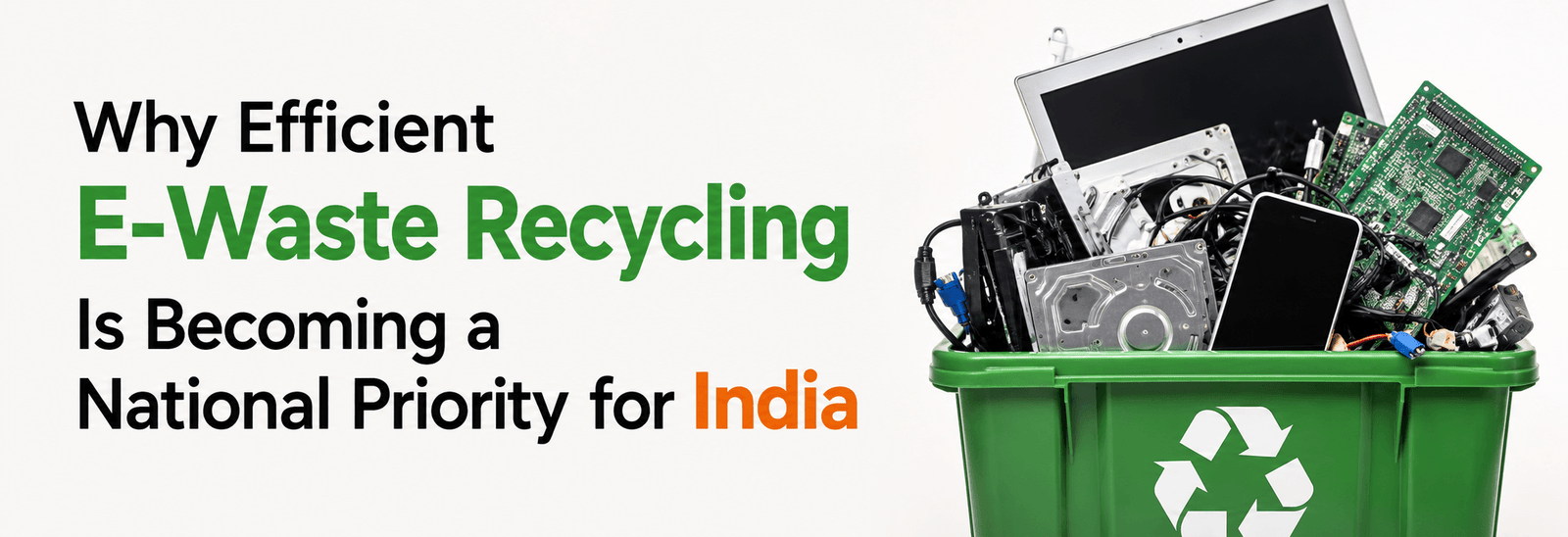
Why Efficient E-Waste Recycling Is Becoming a National Priority for India
Technology has improved communication, productivity, education, healthcare, financial services, and access to information. But there is another side to this rapid digital growth. Every upgraded laptop, replaced smartphone, discarded printer, outdated server, or damaged electronic device eventually reaches a point where it must be reused, refurbished, recycled, or responsibly disposed of. When this process is not managed properly, valuable resources are lost and environmental and health risks can increase.
This is why efficient e-waste recycling in India is no longer simply an environmental concern. It is increasingly connected to resource conservation, public health, responsible business practices, circular economy development, regulatory compliance, employment opportunities, and long-term national sustainability.
India’s regulatory framework has also evolved to address this challenge. The E-Waste (Management) Rules, 2022 came into force on 1 April 2023 and established an Extended Producer Responsibility framework that places defined responsibilities on producers and emphasizes recycling through registered recyclers.
As India’s dependence on electronics continues to grow, the need for efficient, transparent, and environmentally responsible electronic waste management is becoming a national priority.
Why Rapid Digitalization and Shorter Technology Lifecycles Are Increasing E-Waste Generation in India
Businesses replace computers to improve performance and security, consumers upgrade smartphones more frequently, organizations modernize servers, and institutions replace large volumes of equipment during digital transformation projects.
A device may still be physically functional but become unsuitable because its operating system is no longer supported, its performance is insufficient, spare parts are difficult to obtain, or newer technology offers better efficiency. This means that the question is no longer simply how many electronic products India consumes. It is also how effectively the country can manage these products when they reach the end of their first useful life.
A mature e-waste management system needs to support repair, refurbishment, reuse, responsible recycling, material recovery, and safe final disposal wherever necessary.
How Improper Electronic Waste Disposal Can Affect India’s Environment and Public Health
One of the most important reasons for strengthening e-waste recycling is the potential environmental and health impact of improper disposal. When electronic equipment is dismantled, burned, processed, or discarded without appropriate controls, hazardous substances can potentially enter surrounding soil, air, or water. Informal and unsafe processing methods can expose workers and communities to avoidable risks.
The CPCB states that the overall objective of India’s E-Waste (Management) Rules, 2022 is to ensure that e-waste is managed in a way that protects health and the environment from adverse effects.
Responsible e-waste recycling involves controlled collection, transportation, dismantling, processing, recovery, and disposal. These activities should be performed through appropriate infrastructure and processes rather than treating electronic waste like ordinary garbage.
For India, improving these systems is important not only for major metropolitan areas but also for smaller cities, industrial clusters, educational institutions, government organizations, and rapidly developing business hubs. Efficient recycling infrastructure can help ensure that the environmental burden associated with India’s digital growth does not disproportionately affect vulnerable communities or ecosystems.
How E-Waste Recycling Supports India’s Circular Economy and Resource Recovery Goals
Electronic devices are not simply collections of discarded components. They contain materials that can potentially be recovered and reintroduced into productive use. Copper, aluminium, ferrous metals, precious metals, plastics, and other materials can have economic value when recovered through appropriate recycling processes. Recovering these materials reduces the need to rely entirely on virgin resources for future manufacturing.
A circular approach to electronic waste management begins before recycling. Products can be maintained, repaired, upgraded, refurbished, reused, remarketed, and eventually recycled when they can no longer be practically recovered as complete products.
India’s E-Waste (Management) Rules, 2022 also recognize reuse and refurbishment within the regulatory framework. The CPCB identifies the generation of refurbishing certificates as one of the features of the rules. For a country with a large and growing technology market, recovering resources from obsolete electronics can therefore contribute to both environmental protection and resource efficiency.
Why Responsible E-Waste Recycling Is Important for Recovering Valuable Materials in India
The concentration of valuable materials in electronic products has made urban mining an increasingly relevant concept. Instead of extracting every resource from the earth, some materials can be recovered from products that have already entered the economy.
This does not mean every discarded device can be recycled completely or economically. Different products have different compositions and recovery challenges. Nevertheless, systematic collection and professional processing can significantly improve the chances of recovering useful materials.
Efficient precious metal recovery from e-waste can therefore become part of a broader resource-efficiency strategy. The value of this approach extends beyond the recovered material itself. Better recycling reduces the quantity of electronics that ultimately require disposal and encourages businesses and consumers to view old technology as a resource rather than worthless waste.
How India’s E-Waste Management Rules and EPR Framework Are Strengthening Responsible Recycling
The E-Waste (Management) Rules, 2022 replaced the earlier 2016 rules and became effective from 1 April 2023. The framework applies to specified manufacturers, producers, refurbishers, dismantlers, and recyclers involved in the manufacture, sale, transfer, purchase, refurbishing, dismantling, recycling, and processing of covered electrical and electronic equipment.
One of the major elements of the framework is Extended Producer Responsibility, or the EPR framework. The CPCB explains that producers are required to meet recycling targets and that EPR obligations are fulfilled through registered e-waste recyclers within the framework.
The framework also provides for EPR certificates based on recycled end products and includes provisions related to environmental compensation for violations. This regulatory direction demonstrates that e-waste management is moving away from an informal disposal mindset toward a more structured system involving producers, refurbishers, recyclers, and other stakeholders.
For organizations, compliance should therefore be treated as an ongoing operational responsibility rather than an occasional paperwork exercise.
Why Businesses in India Need Efficient Corporate E-Waste Recycling and IT Asset Disposition
An organization may retire hundreds or thousands of laptops, desktops, servers, monitors, printers, networking devices, storage systems, and other electronics during an infrastructure refresh. Without a structured IT Asset Disposition process, these assets can create environmental, financial, operational, and data-security risks.
Corporate e-waste recycling should therefore be connected with IT Asset Disposition. ITAD involves managing technology at the end of its useful business life, including collection, inventory, data sanitization, refurbishment, resale, recycling, recovery, and responsible disposal.
Data security is particularly important. A retired laptop or server may still contain confidential business information. Secure data sanitization should take place before an asset is reused, resold, recycled, or physically destroyed, depending on the circumstances.
A professional ITAD and e-waste management program can bring these processes together, allowing organizations to manage information security and environmental responsibility within a controlled asset lifecycle.
How Efficient E-Waste Collection and Reverse Logistics Can Improve Recycling in India
Recycling cannot happen efficiently if discarded electronics never reach an appropriate processing facility. Collection and reverse logistics are therefore fundamental parts of the e-waste ecosystem. Businesses and consumers need convenient ways to transfer obsolete electronics into responsible recycling channels.
For organizations with offices across multiple cities, this can be particularly challenging. Equipment may be stored at branch offices, warehouses, project locations, employee residences, or temporary sites.
GreenTek Reman provides reverse logistics and pan-India collection capabilities for organizations managing electronic waste and retired IT assets. Its published service information describes collection, transportation, dismantling, recycling, refurbishment, and responsible disposal as interconnected parts of its e-waste management approach.
Efficient collection is ultimately what connects consumers and businesses with the formal recycling ecosystem. Without it, even strong recycling infrastructure cannot reach its full potential.
Why Formal and Certified E-Waste Recycling Is Essential for India’s Sustainable Waste Management
India’s e-waste challenge cannot be addressed effectively through informal disposal practices alone. A professional recycling ecosystem requires appropriate infrastructure, trained personnel, documented processes, environmental controls, and traceability.
Certification can provide an additional layer of assurance when organizations evaluate recycling and ITAD providers. R2v3, for example, is an internationally recognized standard for responsible electronics reuse and recycling that addresses areas including data security, environmental responsibility, repair, and recycling practices.
GreenTek Reman states that it became Asia-Pacific’s first R2v3-certified ITAD and e-waste management company in 2021 and describes its certification as covering data sanitization, downstream recycling, testing and repair, metal recovery, and certified e-waste processing.
For businesses, choosing a qualified recycling partner is not simply about finding someone willing to collect old electronics. It is about understanding what happens to those assets after collection and whether the process supports data protection, environmental responsibility, and regulatory requirements.
Transparency and documentation are particularly valuable for organizations that need to demonstrate responsible disposal to internal management, auditors, customers, or other stakeholders.
GreenTek Reman: Supporting India’s E-Waste Recycling and ITAD Needs Through Secure, Sustainable Solutions
GreenTek Reman is positioned around a clear sustainability philosophy: Reduce, Reuse, and Recycle. The company’s USP lies in combining IT Asset Disposition, secure data sanitization, e-waste recycling, refurbishment, reverse logistics, product and equipment destruction, and precious resource recovery into an integrated service model.
GreenTek Reman describes itself as Asia-Pacific’s first R2v3-certified ITAD and e-waste management company, with a complete e-waste processing facility in Greater Noida, Uttar Pradesh. Its facility processes electronics for reuse, end-of-life disposition, de-manufacturing, and recycling, covering equipment such as computers, laptops, servers, networking equipment, printers, monitors, and other electronics.
The company’s strength is particularly relevant to India’s national e-waste challenge because responsible recycling requires more than collection. It requires secure logistics, controlled processing, appropriate data security, material recovery, documentation, and environmental responsibility.
GreenTek Reman also highlights its pan-India logistics capabilities and offers corporate e-waste management services designed to provide structured collection and processing for organizations.
Its R2v3 certification further supports its positioning around responsible electronics reuse and recycling. The company states that its processes focus on data sanitization, verified downstream recycling, testing and repair, metal recovery, and responsible e-waste processing.
This integrated approach reflects what India’s evolving e-waste ecosystem increasingly needs: not merely disposal, but a secure and sustainable pathway through which obsolete electronics can be collected, assessed, reused, refurbished, recycled, and converted back into useful resources wherever feasible.
Conclusion
Efficient e-waste recycling in India can help protect the environment, reduce uncontrolled disposal, recover valuable materials, support the circular economy, strengthen responsible business practices, and create opportunities for sustainable employment.
However, regulation alone cannot solve the problem. India needs participation across the entire electronics lifecycle. Manufacturers must design and produce responsibly. Businesses need structured IT asset disposition programs. Consumers need accessible collection channels.
Recyclers need appropriate infrastructure and transparent processes. And organizations need to recognize that responsible e-waste recycling is part of long-term sustainability rather than simply an end-of-life obligation.