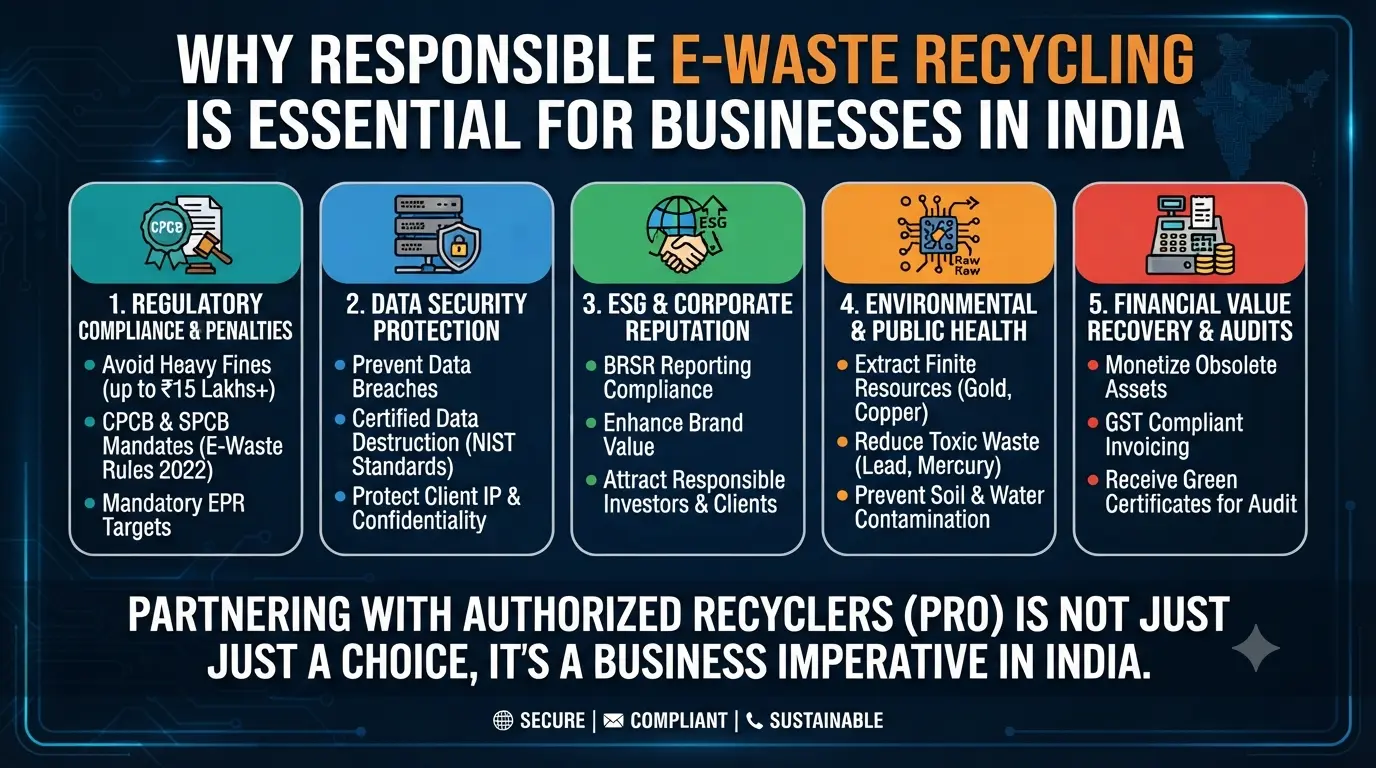
Why Responsible E-Waste Recycling Is Essential for Businesses in India
Outdated computers, damaged electronic equipment, obsolete servers and unused office devices often accumulate in corporate storage rooms without a proper disposal plan. Some businesses sell these assets through informal channels, while others discard them without understanding the environmental, data security and regulatory risks involved. Such practices can lead to hazardous waste management, data breaches and the loss of valuable reusable resources.
In India, where digital transformation and technology adoption are accelerating across industries, responsible e-waste recycling is becoming an essential part of sustainable business operations. Organisations must look beyond simply disposing of obsolete equipment and adopt structured processes that prioritise reuse, refurbishment, resource recovery and environmentally sound recycling.
Responsible e-waste management is not just an environmental initiative. It is a business responsibility that supports regulatory compliance, information security, resource efficiency and long-term sustainability.
Environmental Benefits of Responsible E-Waste Disposal and Recycling in India
One of the biggest reasons businesses should prioritise responsible e-waste recycling is its contribution to environmental protection. Electronic devices contain several materials that require careful handling. Certain components may contain lead, mercury, cadmium and other substances that can pose environmental and health risks when improperly processed.
When electronic waste is dumped in open areas, landfills or unauthorised disposal locations, harmful substances may contaminate soil and water. Informal dismantling and unsafe extraction techniques can also expose workers and nearby communities to hazardous materials.
Responsible electronic waste recycling helps minimise these risks through controlled dismantling, material segregation and environmentally appropriate treatment. Professional recycling processes ensure that reusable materials are recovered wherever possible, while hazardous fractions and non-recyclable residues are managed through appropriate authorised channels.
For businesses, this means their obsolete electronics can be managed without contributing unnecessarily to environmental pollution. Responsible disposal also supports the broader objective of reducing landfill dependency. Instead of treating old electronic equipment as useless waste, organisations can contribute to a system where materials are recovered and redirected towards productive applications.
E-Waste Management Rules in India and the Importance of Regulatory Compliance for Businesses
Responsible electronic waste management is also important from a regulatory perspective. The Government of India introduced the E-Waste (Management) Rules, 2022, under the Ministry of Environment, Forest and Climate Change. These rules came into effect on 1 April 2023, replacing the earlier 2016 framework. The rules have subsequently undergone amendments.
The framework establishes responsibilities for manufacturers, producers, refurbishers, dismantlers and recyclers involved in the management of notified electrical and electronic equipment.
It also introduces an Extended Producer Responsibility (EPR) mechanism through which producers must fulfil their applicable recycling obligations using EPR certificates generated by registered recyclers.
Businesses that qualify as bulk consumers have an important responsibility under these rules. They must ensure that the e-waste generated from applicable electrical and electronic equipment is handed over only to registered producers, refurbishers or recyclers.
For organisations, this makes it important to understand the regulatory requirements relevant to their role and ensure that their electronic waste does not enter unauthorised disposal channels. Partnering with an appropriately registered and professionally equipped recycling organisation can help businesses establish a more accountable disposal process.
Data Security and Confidentiality Risks Associated with Improper IT Asset Disposal
Environmental responsibility is only one aspect of e-waste management. For businesses, information security is equally important. Old laptops, desktops, servers, storage devices and networking equipment may contain confidential corporate information, customer records, financial documents, employee details, intellectual property and business-critical data.
Simply deleting files or formatting a storage device does not necessarily ensure that the information cannot be recovered. If obsolete IT equipment is sold, transferred or discarded without proper data sanitisation, sensitive information may become accessible to unauthorised individuals. This can expose organisations to data breaches, financial losses, reputational damage and potential regulatory consequences.
Responsible IT Asset Disposition (ITAD) addresses this challenge by integrating secure data sanitisation and destruction into the equipment disposal lifecycle. Depending on the asset condition and business requirements, organisations can opt for appropriate data sanitisation, secure storage media destruction or physical destruction processes.
A structured ITAD programme also helps businesses maintain asset-level records and obtain relevant data destruction documentation. This is particularly important for banks, financial institutions, healthcare organisations, IT companies, government departments and enterprises that manage confidential information.
By prioritising data security before recycling or asset recovery, businesses can protect their information while ensuring that obsolete electronic equipment is processed responsibly.
How Responsible E-Waste Recycling Strengthens Corporate Reputation and Business Accountability
Corporate reputation is influenced not only by the products and services an organisation delivers but also by how responsibly it conducts its operations. Improper disposal of electronic equipment can create environmental concerns and raise questions about an organisation’s commitment to sustainability.
On the other hand, implementing responsible e-waste recycling demonstrates a proactive approach towards environmental protection and resource management. It can strengthen stakeholder confidence by showing that the organisation takes its environmental responsibilities seriously.
For companies working with international clients, large enterprises and sustainability-conscious partners, responsible waste management can also support broader supplier sustainability expectations.
Furthermore, a documented e-waste disposal process helps organisations demonstrate accountability during internal reviews, environmental assessments and relevant compliance evaluations. By making responsible electronics disposal a regular business practice, organisations can build a stronger foundation for sustainable and transparent operations.
GreenTek Reman: Supporting Responsible E-Waste Recycling and Sustainable IT Asset Management Across India
Choosing the right recycling partner is an important part of implementing a responsible e-waste management strategy. Businesses need a partner that understands environmental requirements, information security, asset recovery and the operational challenges associated with bulk electronic waste disposal.
GreenTek Reman is Asia-Pacific’s first R2v3 Certified ITAD and E-Waste Management company, providing end-to-end solutions for organisations seeking secure, sustainable and environmentally responsible electronic waste management.
With its expertise in IT Asset Disposition, e-waste recycling, refurbishment, dismantling and precious metal recovery, GreenTek Reman helps businesses manage their obsolete electronic equipment through structured and responsible processes.
Through its IT Asset Disposition solutions, GreenTek Reman helps organisations manage retired laptops, desktops, servers, storage devices, networking equipment, telecom assets and other electronic equipment. Secure data sanitisation and destruction services help protect confidential business information before assets move towards reuse, recovery or recycling.
Its e-waste recycling and dismantling capabilities focus on systematic processing and material recovery. GreenTek Reman prioritises the recovery of valuable resources from discarded electronics, supporting a more sustainable approach to electronic waste management.
The company also offers Extended Producer Responsibility (EPR) support, helping businesses navigate relevant requirements through services such as CPCB registration assistance, EPR portal management, regulatory filings and training.
With PAN-India collection and logistics capabilities, GreenTek Reman helps organisations coordinate electronic waste pickup across different business locations. Its approach is designed to make bulk e-waste management more organised, transparent and convenient.
The company’s sustainability-driven operations focus on achieving up to 99% material recovery, minimising landfill dependency and promoting the responsible utilisation of recovered resources.
What further strengthens GreenTek Reman’s value proposition is its commitment to recognised international practices. Its R2v3 certification reflects its focus on responsible electronics reuse and recycling, environmental health and safety, and controlled IT asset disposition processes.
For organisations looking to improve their environmental performance, protect sensitive business information and manage obsolete IT infrastructure responsibly, GreenTek Reman offers an integrated approach that connects sustainability with practical business requirements.
Whether a company needs bulk e-waste collection, secure data destruction, IT asset disposition, electronic dismantling, precious metal recovery or EPR-related assistance, GreenTek Reman works towards making responsible e-waste management an essential part of its business operations.
Conclusion
As businesses continue to adopt new technologies and upgrade their electronic infrastructure, the responsibility of managing obsolete equipment will become increasingly important.
Responsible e-waste recycling is no longer simply an environmental consideration. It is an essential business practice that supports regulatory compliance, information security, resource recovery, corporate sustainability and operational accountability.